Microsoft's AI Research Tool Turned a Year of Chemistry Work Into Two Hours for This 360-Year-Old Company
Saint-Gobain used Microsoft Discovery to scan 106,000 research documents and find new molecules for greener cement. The catch: those molecules still have to work in the real world.
Key points
- Microsoft Discovery, an AI platform that uses software agents to search scientific literature and generate research hypotheses, helped Saint-Gobain process 62,000 patents and 44,000 research abstracts in a few hours, work its researchers estimated would have taken a year.
- The project targets cement additives, a product category linked to roughly 7% of global CO2 emissions annually.
- Saint-Gobain signed a framework partnership with Microsoft in July 2026 and named its first-ever chief artificial intelligence officer in September 2026.
- The AI-generated molecule candidates are currently being tested in physical lab conditions; no commercial product exists yet.
Saint-Gobain has been making glass since Louis XIV needed mirrors for Versailles. Three and a half centuries later, the French construction-materials giant is using artificial intelligence to try to fix one of the most stubborn environmental problems in its industry: cement.
Cement production accounts for around 7% of global CO2 emissions every year. The main culprit is clinker, the binding ingredient made by super-heating limestone. Saint-Gobain already sells an additive called EnviroAdd that cuts clinker use by about 20%. Now it wants to go further, and it turned to Microsoft Discovery to find out whether chemistry from completely different industries might point the way.
What did the AI actually do?
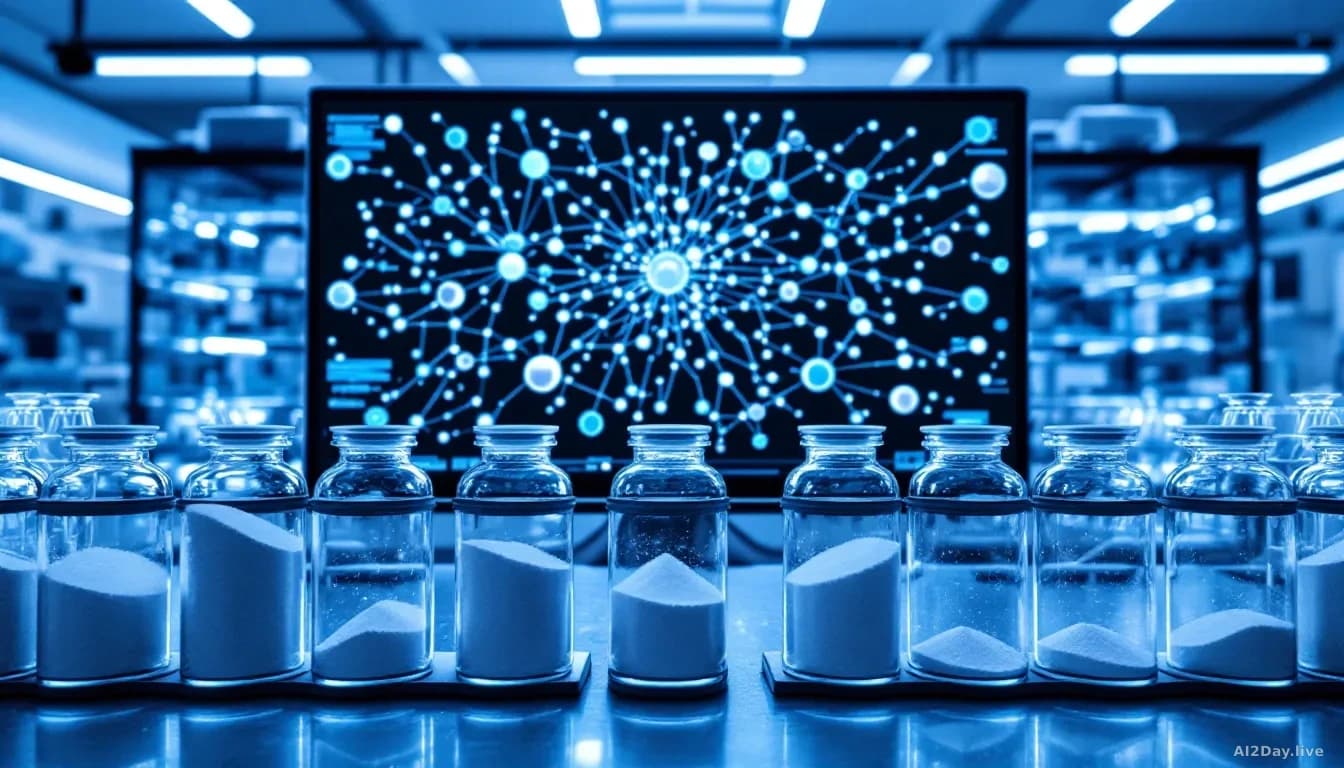
Microsoft Discovery is an agentic platform, meaning it uses AI agents (software that carries out multi-step tasks on its own, rather than just answering a single question) to search scientific literature, spot connections across research fields, generate hypotheses and run analyses. Think of it as a tireless research assistant that can read a small library overnight.
In Saint-Gobain's case, the platform processed 62,000 patents and 44,000 research abstracts. "It would have taken our researchers a year to create the knowledge base," says Mojdeh Rastgoo-Lemaitre, a digital acceleration program manager on the project, as reported by Microsoft AI. "Using AI, it took us a couple of hours."
Within roughly six weeks, the team had a shortlist of novel molecules to test, some from fields far outside construction. Those molecules are now being evaluated in the lab. A commercial additive is a long way off, but the direction of research shifted measurably faster than it would have otherwise.
Who actually built the tool and how does the partnership work?
The Microsoft engineers embedded with Saint-Gobain came from a unit called the Microsoft Frontier Company, which places technical staff inside client organisations rather than selling software and leaving. Both companies formalised the relationship with a framework agreement in July 2026.
Saint-Gobain has been expanding its internal AI capacity at the same time. In September 2026 it appointed Annica Hagen as its first chief artificial intelligence officer. The company also uses AI to run a cut-to-order system for plasterboard that, according to chief digital officer Ursula Soritsch-Renier, improved installation time by 30% and cut landfill waste.
This is genuine industrial AI use, not a demo. But the molecules Discovery surfaced still need to perform in physical cement under real construction conditions, and that testing phase is where promising AI-led research often stalls. Our 28 September story on Anthropic's biology AI claim made exactly this point: finding a pattern is the easy part. Saint-Gobain's scientists know it too, which is why Rastgoo-Lemaitre describes the AI output as hypotheses worth testing, not answers.
Our earlier coverage from 14 October noted Microsoft building its own AI chips to run its Office suite, and earlier this week Microsoft's president was making the case for tighter AI rules. Discovery fits the same logic: Microsoft wants to be the infrastructure layer wherever AI meets serious work.
Common questions
Is Microsoft Discovery available to ordinary businesses?
Discovery launched in private release in March 2026 with Saint-Gobain as one of its first clients. Broad commercial availability hasn't been confirmed publicly, so for now it's a tool for large enterprise partners working directly with Microsoft.
Does this mean AI will replace scientists?
Not in any near-term sense. At Saint-Gobain, Discovery narrowed the search space and surfaced molecules the researchers say they wouldn't have found on their own, but human chemists are still running every physical test. The AI shortened the reading and pattern-matching work, not the laboratory work.
What is the privacy angle for companies using tools like this?
Feeding proprietary research and patent data into any AI platform means that data leaves your internal systems. Companies negotiating enterprise AI deals should confirm in writing whether their inputs are used to train shared models, and which jurisdiction's data laws apply. The source material doesn't detail Saint-Gobain's specific contractual terms.