AI Tool Simulates Hurricane-Scale Weather Detail at 1/300th the Cost of a Traditional Model
HiRO-ACEv2, from the Allen Institute for AI, generates global storm maps at 3-kilometre resolution while matching rare extreme events to within 3 percent accuracy.
Key points
- HiRO-ACEv2 runs global weather simulations at 3-kilometre resolution for roughly 1/300th the computing cost of X-SHiELD, the high-resolution numerical model it was trained on.
- It matches the statistics of rare extreme events, including those that occur only once in every million data points, to within 3 percent accuracy.
- HiRO-ACEv2 now simulates wind speed and air pressure alongside rainfall, expanding on the precipitation-only HiRO-ACEv1.
- The model cannot yet simulate future or historical climates; the Allen Institute for AI plans to train a version on a scenario 4°C warmer than today.
- Winds and pressure around a hurricane's eye are somewhat more lopsided in HiRO-ACEv2 than in the reference model.
A research team at the Allen Institute for AI has built a tool that can generate a full year of detailed global weather data, down to the scale of individual storm bands, for a fraction of what that computation normally costs.
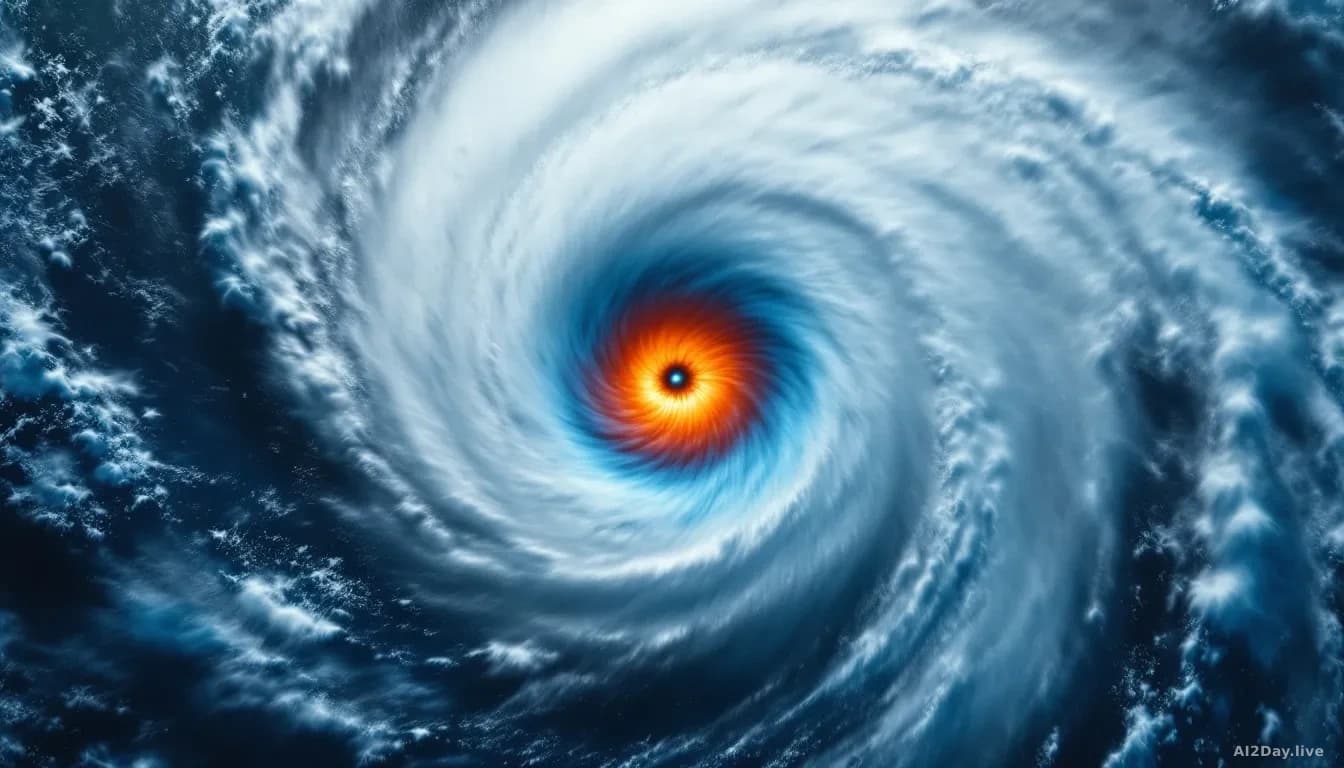
The tool is called HiRO-ACEv2, short for High Resolution Output Ai2 Climate Emulator version 2. It works in two steps: a first AI model sketches the broad weather picture at a coarse 100-kilometre grid, then a second model, trained using a technique called diffusion (the same family of technology behind AI image generators), sharpens that sketch to a fine 3-kilometre grid. That sharpening step is where storms get their detail: the swirl of a hurricane's eye wall, the gusts pouring down a mountainside, the rain bands spiralling outward from a cyclone's centre.
The system was published on arxiv.org and released alongside downloadable models and tutorial notebooks.
What does 1/300th the cost actually mean?
Running a traditional global storm-resolving model requires enormous clusters of specialised chips working for days or weeks. HiRO-ACEv2 produces comparable output in a small fraction of that time.
Climate researchers routinely need not one simulation but dozens or hundreds, each tweaking slightly different conditions, to understand how rare events behave. At standard costs those large ensemble runs are simply unaffordable for most research groups; at 1/300th the cost they become routine. For regional studies rather than global ones, the saving grows further: the team says regional runs can cost more than 100 times less than a full traditional simulation.
How accurate is it on the storms that matter most?
Reasonably well, with caveats the authors are upfront about.
When given real X-SHiELD data as its starting point, HiRO-ACEv2 reproduces the statistics of extreme events, including one-in-a-million occurrences, to within 3 percent. Over a 10-year free-running simulation, its hurricanes' total energy matches X-SHiELD's output. The model generates hurricanes it never saw during training, complete with realistic eyes and rain bands, though the team flags openly that winds and pressure around the eye are somewhat more lopsided than in the reference model.
For people in hurricane-prone regions, the practical upshot is that a larger pool of simulated storms sharpens long-range risk estimates. That complements the shorter-term gains we covered on 10 September when Google's AI weather model gave forecasters an extra day's warning on hurricanes, and it's the sixth Allen Institute for AI story AI2Day has published since late July.
What can it not do yet?
HiRO-ACEv2 learned from one specific model of today's climate. It cannot simulate a warmer future or reproduce historical records from datasets like ERA5. The team's next priority is training on an X-SHiELD dataset set in a world 4°C warmer, which would let researchers study how hurricane behaviour and extreme rainfall shift as the planet heats up. Near-surface temperature and snow and ice outputs are also missing for now.
This is genuinely useful science, but it's a fine-tune on a single reference model, not a universal climate simulator. Researchers who need past storms or scenarios beyond what X-SHiELD covers will still need other tools.
The timing is pointed. As AI2Day has reported, AI agents already consume far more power than simple chatbots, and data centre energy demand keeps climbing. A tool that cuts climate simulation costs by 300 times is at least a partial answer to critics who argue AI consumes more energy than it saves. Whether it's enough of an answer depends on how many researchers actually adopt it.