Swarmer Agrees to Buy Ukrainian Robot-Vehicle Maker Ratel Robotics for Up to $224 Million
The Austin-based drone-swarm software company says the deal will pair its battlefield AI with Ratel's ground robots, which already account for more than a third of Ukraine's military spending on unmanned ground vehicles.
Key points
- Swarmer Inc. Signed an agreement to acquire Ratel Robotics, a Kyiv-based maker of military ground robots, for up to $224 million in cash and stock if all performance targets are met.
- Ratel secured contracts totalling $86 million in 2026 and its vehicles represent about 37% of Ukrainian Ministry of Defense spending on unmanned ground vehicles from January 1 to April 18, 2026.
- Swarmer's autonomy software has completed more than 100,000 combat missions in Ukraine since its first deployment in April 2024.
- The combined company will have nearly 500 employees across the United States, Ukraine, Poland and Estonia.
- Defense-sector investment reached $14.6 billion globally as of June 2, 2026, compared with $9.6 billion for all of 2025, according to Crunchbase.
Swarmer Inc., an Austin, Texas company that makes software for controlling large fleets of drones and robots, has agreed to buy Ukrainian ground-robot manufacturer Ratel Robotics for up to $224 million in cash and stock, with the final figure depending on whether Ratel hits agreed performance targets.
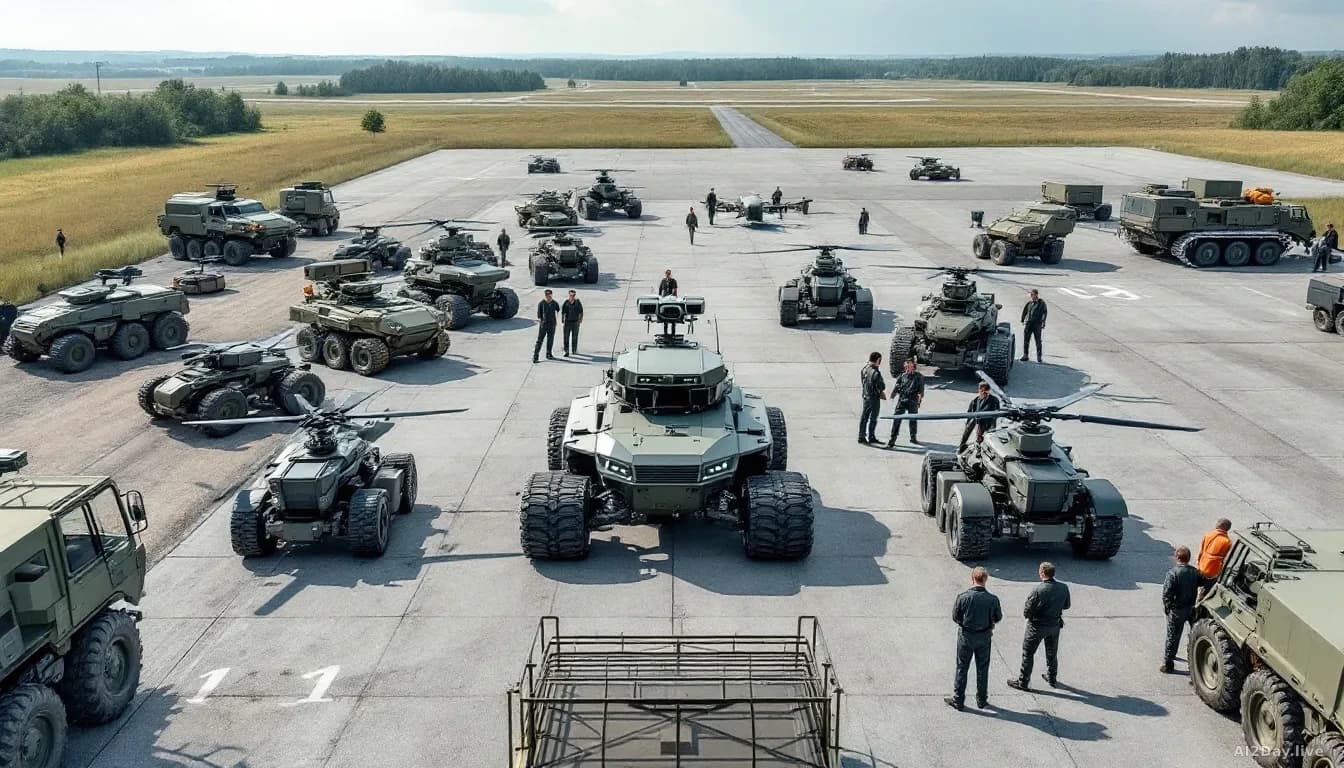
Ratel, founded in Kyiv in 2023, builds UGVs, short for unmanned ground vehicles, which are remotely controlled or autonomous robots that move on land rather than in the air. Ukraine's military uses them to carry supplies, evacuate casualties, scout positions and launch aerial drones, without putting a soldier in the line of fire.
What does Swarmer actually do?
Swarmer writes the software layer that lets a single human operator direct hundreds of drones or robots at once, a capability called swarm coordination. Think of it as air-traffic control software, except the aircraft are cheap autonomous machines acting as a team.
The company says its system currently supports up to 690 drones per swarm and has logged more than 100,000 combat missions in Ukraine since April 2024. Those real-world deployments generate data that continuously improves its machine-learning models, the mathematical systems that let the software make smarter decisions over time.
Combining Swarmer's coordination software with Ratel's ground vehicles is the core logic of the deal. A UGV can carry and launch aerial drones from forward positions, meaning a swarm could start much closer to its target than if every drone launched from a fixed base.
Why does this deal matter beyond Ukraine?
Both companies are already chasing NATO customers. Every Ratel H and Ratel M model carries a NATO stock number and meets AQAP 2110, the alliance's standard for quality assurance in design and production. Ratel is also in talks with multiple NATO member nations under the "Build With Ukraine" initiative.
Swarmer chairman Erik Prince, who co-founded the private security firm Blackwater, framed the deal as part of a broader strategy: find battlefield-proven technology and give it the sales infrastructure to scale internationally. The Pentagon's top AI official said in September that US partners lack the scale and experience to match America's pace, which is precisely the gap deals like this one are designed to close.
"Ukrainians have figured out how to wage war in a low-cost way, vastly superior to what the Western defense cartel has been able to do," Prince said in a statement. Swarmer co-founder Alex Fink noted that Ratel has no dedicated sales staff or lobbyists: combat units simply request the product because they trust it, he told The Robot Report.
What happens to Ratel's existing contracts?
Existing contracts are unaffected, Fink confirmed. Ratel's more than 300 employees are expected to join Swarmer once the deal closes, bringing the combined headcount to nearly 500. Ratel CEO Taras Ostapchuk, a Ukrainian army veteran who founded the company, will keep his title and run Ratel as a wholly owned subsidiary.
Closing still requires regulatory and shareholder approval, so the timeline isn't yet fixed.
| Metric | Figure | Period |
|---|---|---|
| Deal value (maximum) | $224 million | 2026 |
| Ratel contracts secured | $86 million | 2026 |
| Ratel share of Ukraine MoD UGV spend | 37% | Jan 1 to Apr 18, 2026 |
| Swarmer combat missions completed | 100,000+ | Apr 2024 to present |
| Swarmer max drones per swarm | 690 | Current software |
| Combined employee count (post-close) | ~500 | Expected 2026 |
The pattern here is what warrants watching. War-zone robotics is moving fast from niche hardware to a structured, investor-backed industry, and NATO allies are increasingly willing to buy systems proved under fire rather than developed in a test lab. Whether Swarmer can hold that battlefield credibility once it acquires a balance sheet and a lobbying apparatus is the question Prince's own quote quietly raises.