Robot arms at Zalando can now sort returns they have never seen before
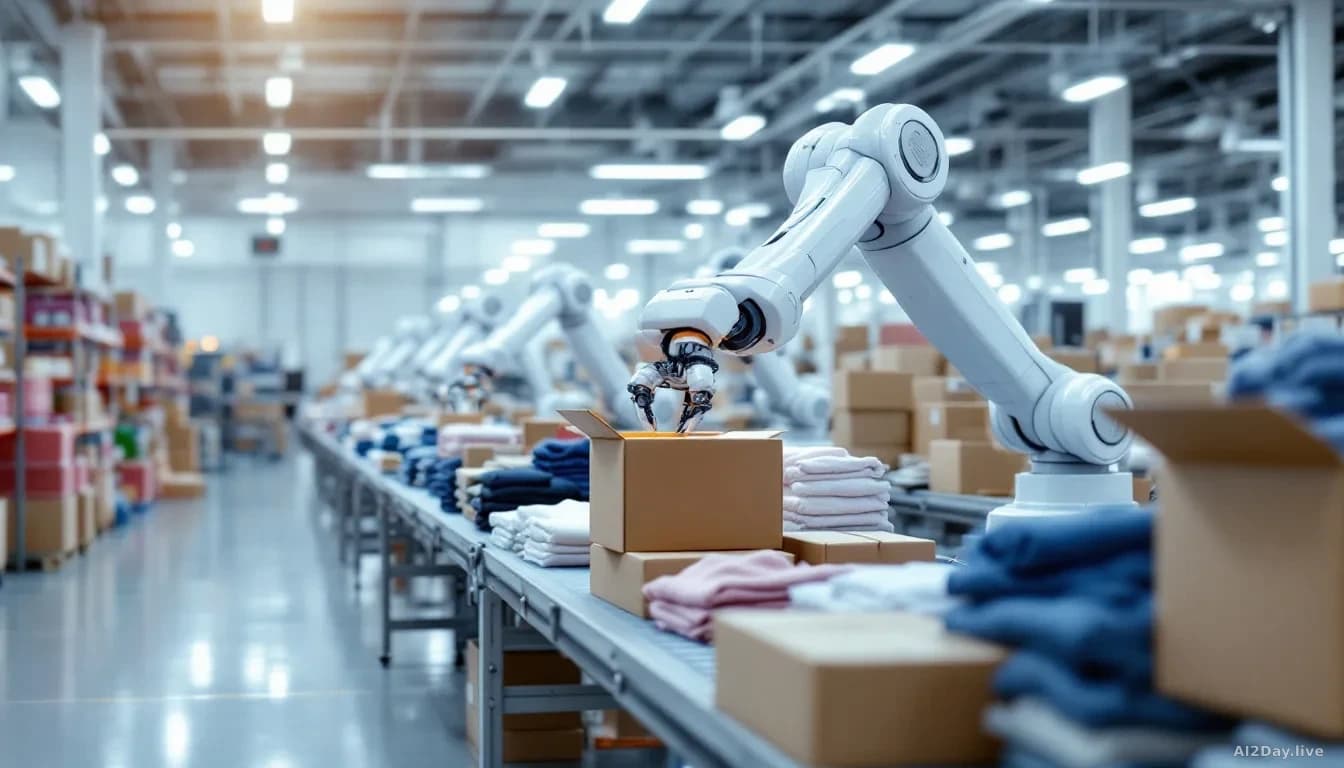
Teradyne Robotics and Sereact say their joint system is already handling returned fashion items at Zalando warehouses in Germany and Poland, with no retraining needed when products change.
Key points
- Sereact's Cortex platform, software that lets robot arms grasp and identify objects they have never encountered before, is live at Zalando fulfillment centres in Greven, Germany, and Świebodzin, Poland.
- Teradyne Robotics, parent of Universal Robots and Mobile Industrial Robots, announced the Sereact partnership at NVIDIA GTC Berlin 2026.
- Cortex trains inside NVIDIA Isaac Sim, then refines itself through reinforcement learning inside NVIDIA Isaac Lab before any model touches a real warehouse.
- Teradyne is contributing digital robot models to SimReady Central on Hugging Face, a shared library where developers reuse simulation-ready assets without rebuilding them from scratch.
- Sereact opened a US headquarters in Charlestown, Massachusetts, this summer.
Returns are logistics' worst nightmare. A box arrives. Nobody knows what is inside. Shape and packaging change with every item. A human worker handles it instinctively, but a traditional robot needs reprogramming for each new product type, which makes automation impractical for the chaos of fashion returns.
Sereact's answer is a system it calls Cortex. One trained brain sits above every robot arm on a site. When one robot figures out how to handle a new item, every robot on the network benefits immediately. No retraining per item, no per-task customisation.
How does the AI actually learn to do this?
Cortex starts in simulation. It trains inside NVIDIA Isaac Sim, an open simulation framework that uses GPU-accelerated physics (meaning the maths of how objects fall and collide is calculated on specialised chips) to create a convincing virtual warehouse, letting the system practise millions of grasps before touching a real product.
After that first stage, the model goes through reinforcement learning (a technique where software improves itself through millions of trial-and-error attempts) inside Isaac Lab, the framework Nvidia built for robot policy training. We covered Isaac Lab's simulation capabilities on 23 September, when a Hugging Face tutorial showed how moving from a single CPU to thousands of parallel GPU environments could drastically shorten robot training times. Only once Cortex passes benchmarks on real Teradyne hardware does it ship to a live site.
At Zalando, the deployed system runs on NVIDIA Jetson Thor, a compact edge computing chip, at the robot cell where split-second decisions are needed. A larger NVIDIA DGX Spark system handles site-level model updates.
Teradyne is also contributing digital twins of its Universal Robots and Mobile Industrial Robot products to SimReady Central on Hugging Face, so any developer building a warehouse simulation can drop in accurate robot models without weeks of preparation.
What does this mean for people working in logistics?
The Zalando deployment is the first phase of a broader plan to scale returns automation across Europe. The system also helps retailers meet EU rules that ban the destruction or landfill disposal of returned goods, because faster reconditioning puts more products back on shelves.
Teradyne says it's already shipped hundreds of robot systems to live European sites through this partnership. The deployment is also timed neatly with Nvidia's own tooling push: on 25 October, Nvidia upgraded Cosmos with synthetic video tools designed to cut real-world test scenarios for physical AI, and Cortex's training pipeline uses those same Cosmos world models.
The honest caveat: these are company figures from a conference announcement, first reported by The Robot Report. Independent performance data from the Zalando sites hasn't been published. That's the number to watch.
Common questions
Does the robot need to be taught every item it will ever pick?
No. Cortex is designed to handle items it's never seen before, trained on varied shapes and packaging types in simulation. New items don't require a separate training run.
Who makes the robots being used here?
The arms come from Universal Robots, a Danish company owned by Teradyne Robotics, a US-based industrial technology group. The AI software running on them is from Sereact, a German startup with a new US office in Massachusetts.