NVIDIA's Cosmos 3 Edge Brings Robot Brains Down to Earth
A new, compact AI model lets robots and factory cameras think for themselves, without needing a data centre nearby.

Key points
- NVIDIA released Cosmos 3 Edge, a 4-billion-parameter AI world model designed to run on small edge devices rather than large data-centre servers.
- The model ranks first among similar-size models on VANTAGE-Bench, a benchmark test for vision-based AI tasks in smart buildings and robotics.
- Running on NVIDIA Jetson Thor hardware, it processes 32 predicted robot actions per inference cycle at 15 frames per second, fast enough for real-time control.
- NVIDIA also released a companion policy model trained on the DROID dataset, a publicly available collection of robot manipulation recordings, for pick-and-place tasks.
Imagine a robot arm in a hospital supply room. It needs to spot a box, reach for it, predict what happens when its fingers make contact, and adjust if something shifts. Until recently, doing all of that at once required a connection to a powerful server miles away. NVIDIA wants to change that.
NVIDIA published Cosmos 3 Edge to Hugging Face, the open-source AI repository where researchers share models freely. We first covered the model on 19 July in our report on NVIDIA's robot-brain push and its Japanese AI partnerships; this release fills in the technical detail.
The phrase "world model" carries real weight here. A world model is AI software that learns how a scene changes over time: it doesn't just recognise objects, it predicts how they'll move, what an action will cause, and which move to make next. Think of it as giving a machine a rough sense of cause and effect.
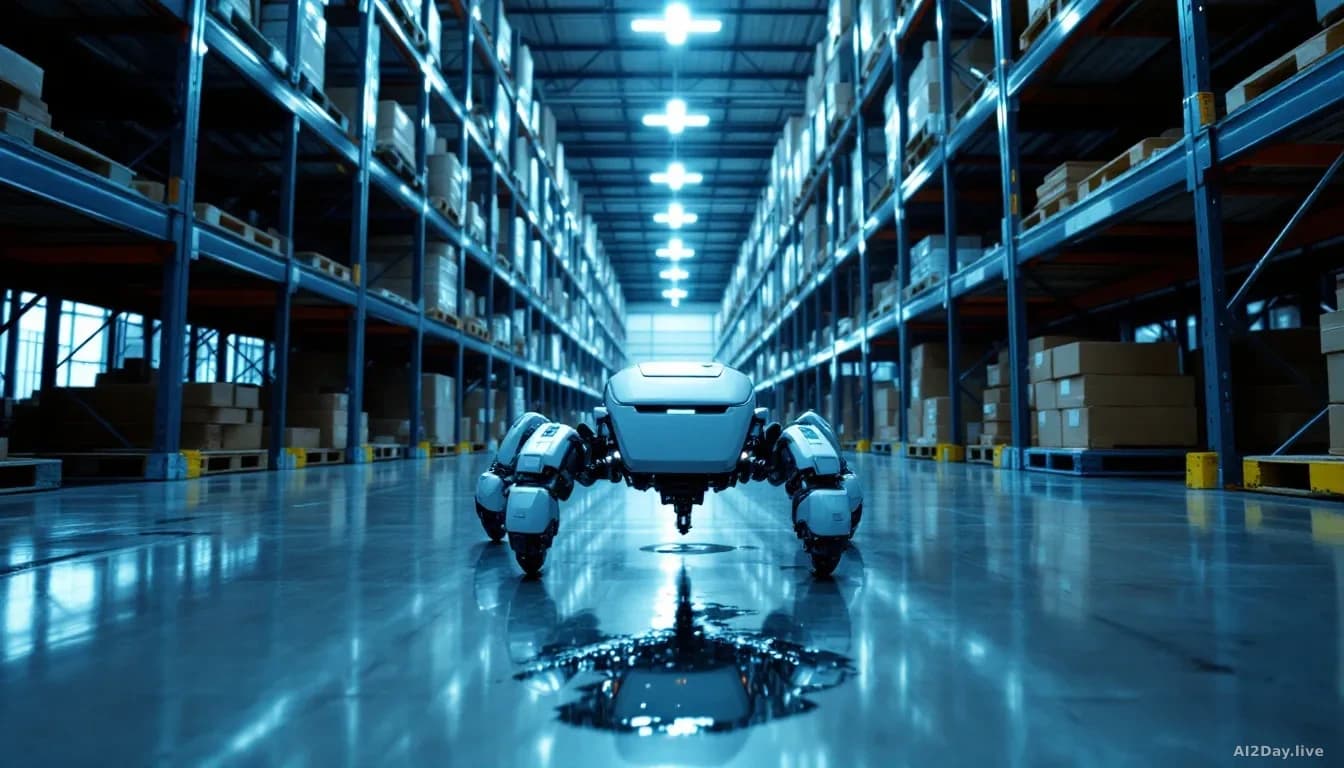
Cosmos 3 Edge does this with 4 billion parameters, where a parameter is a single adjustable number inside the model that shapes how it thinks. Top chatbot models carry hundreds of billions. At 4 billion, the model fits on edge devices, the small computers built into machines on factory floors and hospital corridors, rather than sitting in a cloud data centre.
How does it actually control a robot?
The model predicts what to do and shows what should happen next in the same step. Feed it an image of a table with a banana and the instruction "pick up the banana and put it in the plate", and it outputs both the physical movements for the robot arm and a visual simulation of how the scene should look once those movements happen.
NVIDIA built the model with two linked processing systems sharing a common understanding of the scene. One handles language and visual reasoning; the other handles prediction and action generation. They share a common attention layer, the part of the model that decides which pieces of information matter most at any moment, keeping both sides in sync.
Actions from very different machines, a robot gripper or a vehicle steering system, all get translated into the same compact mathematical format. One model can potentially serve several machine types with minimal retraining, which is the practical upside developers will care about most.
For developers, NVIDIA is releasing training scripts and a ready-to-use version fine-tuned for pick-and-place robot tasks. Teams can adapt the base model using a small cluster of H100 GPUs, the specialised chips that do the heavy number-crunching AI needs, before pushing it to cheaper edge hardware in the field.
NVIDIA also released a faster version of a larger companion model that cuts internal processing steps from up to 50 down to just 4, delivering up to 25 times faster image and video generation.
Cosmos 3 Edge is available now as a free download from Hugging Face.