Amazon's One Million Robots Now Have a Brain That Plans Together
A new AI system called DeepFleet coordinates hundreds of thousands of warehouse robots at once. What does that mean for the workers beside them?
Key points
- Amazon trained DeepFleet, a suite of AI coordination models, on movement data from hundreds of thousands of robots across its warehouses worldwide, according to a paper published on arxiv.org.
- DeepFleet uses four different AI architectures, each designed to approach the problem of moving large robot fleets from a different angle.
- Amazon already operates more than one million robots and employs more than 1.5 million people, making it the second-largest corporate employer on Earth.
- A George Mason University professor says collaborative robots can dictate the pace of human work in a way older machines never could.
- The coordination layer is getting smarter; the human pace question is not settled.
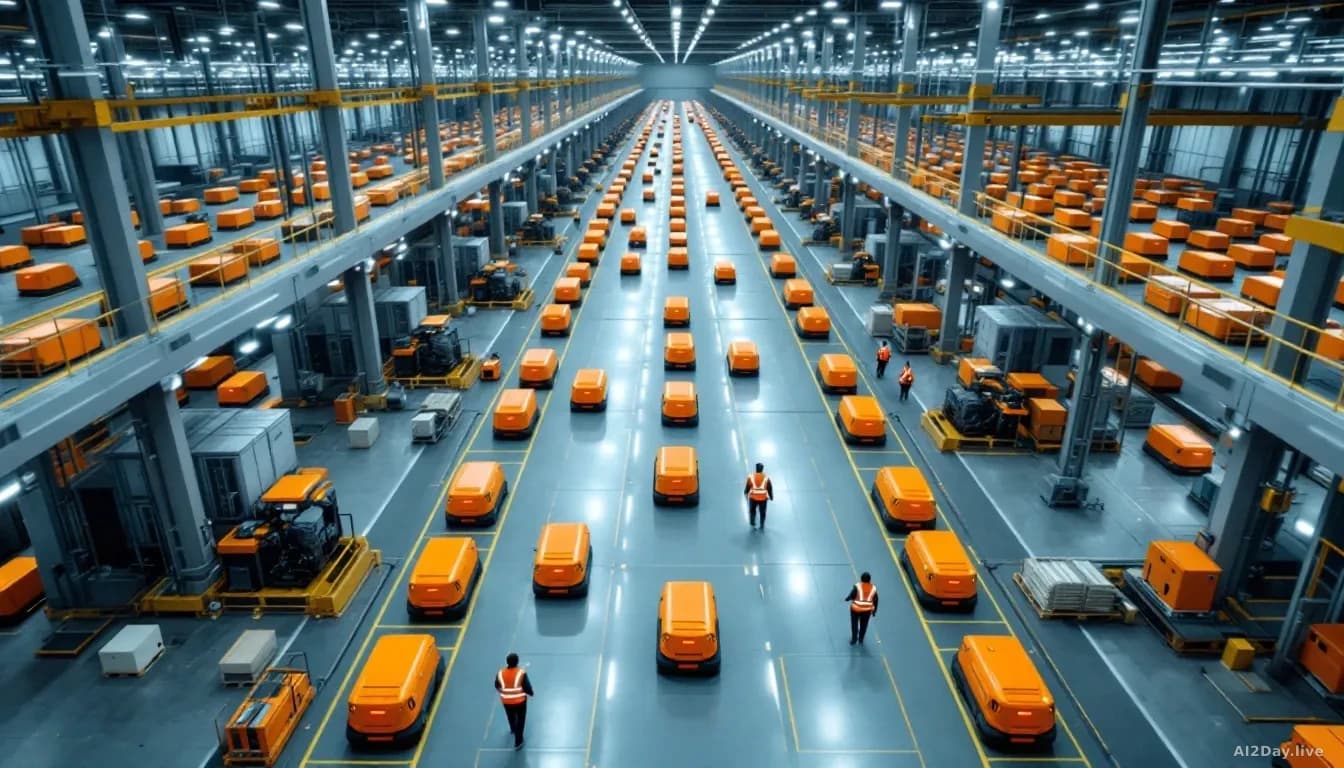
Step inside an Amazon fulfilment centre and the scale hits you fast. Yellow tote bins ride conveyors. A robot arm stacks them onto pallets. Another arm called Robin grabs soft mailers, reads each label, checks for damage or illegible addresses, and sorts the package onto a carrier. All of it, constantly, without a break.
Now Amazon has published the engineering behind what coordinates all of that: DeepFleet, a set of foundation models (large AI systems trained on enormous datasets, similar in concept to the technology behind ChatGPT) built specifically to plan and coordinate massive fleets of mobile robots.
What did Amazon actually build?
DeepFleet is not a single model. It is four, each with a different way of thinking about the traffic problem.
One model, called the robot-centric architecture, works like a lookout: it focuses on each individual robot and its immediate neighbours. A second, the robot-floor model, holds a wider view, cross-referencing robot positions against a map of the whole warehouse floor. A third, the image-floor model, reads the entire fleet as an overhead picture using convolutional encoding, a technique borrowed from how AI systems process images. All four were trained on real movement data from hundreds of thousands of robots operating in Amazon facilities around the world.
The goal is smoother traffic: fewer jams, faster routes, less time wasted when one robot waits for another to pass. At a million-robot scale, even small gains compound into meaningful throughput, and that throughput directly determines how many packages reach a doorstep the same day an order is placed. Our 17 September story on why robots are still waiting for their data moment noted that training data scarcity is the core bottleneck for general-purpose robots. DeepFleet is Amazon's answer for its own closed environment: train on your own fleet, at scale, and the data problem largely solves itself.
Does this make the human workforce safer, or more pressured?
Amazon says yes to the first part. The company points to robots taking over tasks most likely to cause fatigue and injury.
But the reality on the floor is more complicated. Brian Greenwood, a professor of business at George Mason University, told Ars Technica that older automation usually happened away from workers. Collaborative robots are different on two counts: they work right beside people, and they can set the pace of work. A human keeping up with Robin isn't choosing their own rhythm.
That tension sits at the centre of a debate this site has tracked since July. A piece from 6 October asked who survives the coming physical-AI patent wars, and who actually gets to decide what AI does to the economy examined the policy vacuum underneath the technology. DeepFleet is a concrete answer to the technical coordination problem. The labour side has no equivalent.
Amazon's fleet will keep growing. The smarter the coordination layer gets, the faster each robot moves, and the faster each human beside it is expected to keep up. Watch that number, not the robot count alone.



