One operator, one button: Xpanner's robot arm now lifts solar panels so crews don't have to
A California startup has turned a standard excavator into an automated solar panel lifter, cutting a ten-person manual crew down to three.
Key points
- Xpanner Global launched the X1 Panel Lift on 14 July 2025, adding automated panel lifting to its existing excavator kit.
- The system reduces a typical ten-person manual installation crew to three workers.
- One operator with roughly one to two hours of training can run the machine by pressing a single button.
- Xpanner has raised $38 million in total funding, including an $18 million Series B bridge round closed in May 2025.
- The kit retrofits onto excavators contractors already own, so no new machine purchase is needed.
Solar farms are enormous. A utility-scale site might need workers to carry and position hundreds of thousands of heavy panels by hand. It's slow, back-breaking labour, and the solar industry is running short of people willing to do it.
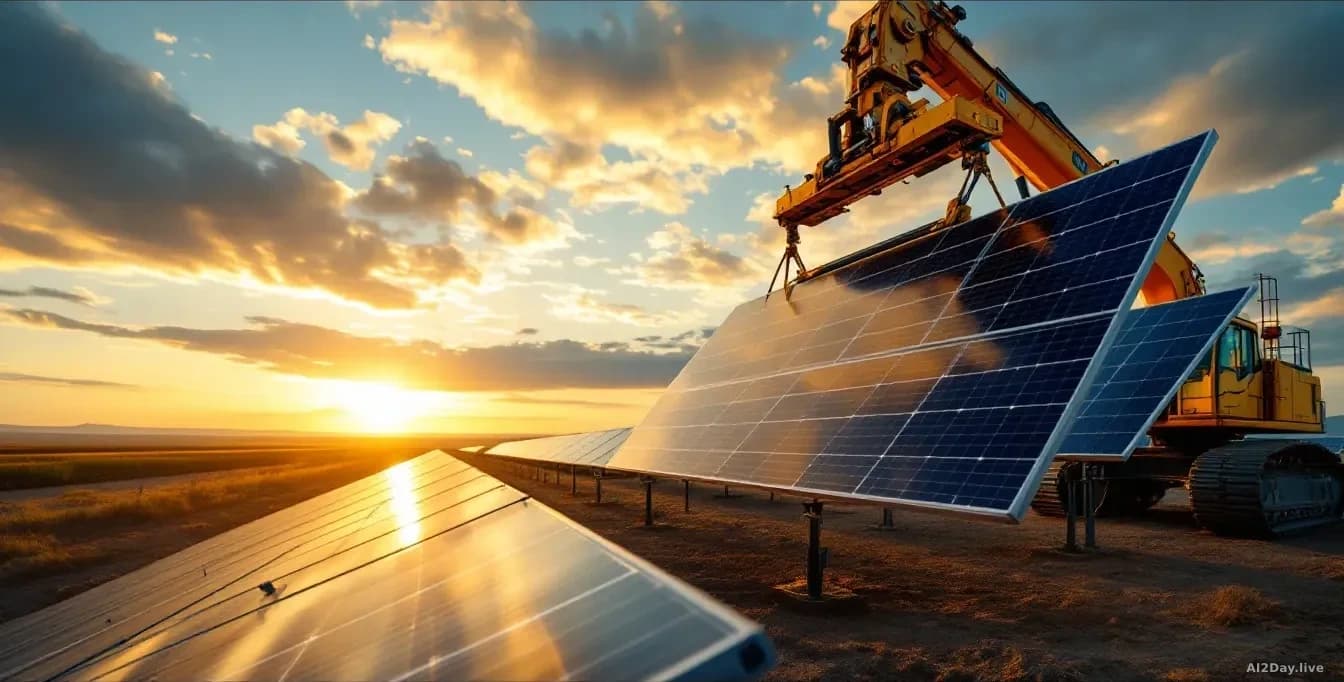
Xpanner Global, a construction-robotics startup based in Santa Fe Springs, California, thinks it has a fix. On 14 July 2025 the company released the X1 Panel Lift, a kit that bolts onto a standard excavator and turns it into an automated panel-lifting machine. The arm picks up a panel via a suction device, swings it into position, and places it precisely, all from a single button press.
Panel bolting still happens by hand, so the recommended crew is three people: one operator running the machine, one worker on each side fastening panels as the arm delivers them. That's down from the ten-person crews manual installation typically needs.
"Solar installation has long been held back by its dependence on large skilled crews and complex equipment setups," said Henri Lee, Xpanner's co-founder and CEO, in remarks to The Robot Report. "One machine, one button, one workflow, any operator can run it from Day 1."
The brains of the system is a controller Xpanner calls Mango. It pulls from lidar (a laser-based distance scanner), cameras and GNSS (satellite positioning) simultaneously, blending those streams into a live three-dimensional map of the jobsite so the arm knows exactly where each panel needs to go as ground conditions shift.
Does the excavator brand matter?
No. The X1 Panel Lift is a retrofit, so Xpanner's hardware attaches to whatever excavator a contractor already owns. Brand and model are irrelevant, Lee told The Robot Report.
That matters for cost. Contractors skip a multi-hundred-thousand-dollar equipment purchase and instead pay a single subscription covering the hardware kit, software licence, a monitoring dashboard called Xpanner Connect, and on-site field support.
Xpanner Connect doubles as a digital twin, a live digital copy of the physical site that updates in real time as panels go down. Project managers can track progress remotely, which helps avoid the schedule overruns that plague large solar builds. Even a single lost day on a utility-scale project can carry a steep financial penalty, Lee noted.
The platform was previously used for driving the steel piles that anchor panel rows into the ground. Xpanner says the same kit will handle additional tasks through software updates rather than new hardware purchases, which is the more interesting long-term claim and the one worth watching: if that extensibility holds at scale, the subscription model starts to look genuinely different from conventional equipment rental.
Founded in 2020, the company employs teams in California and Seoul, South Korea, and counts the United States as its primary market. It raised an $18 million Series B bridge round in May 2025, bringing total funding to $38 million.