Apple Runs a Nearly-Trillion-Parameter AI Model Across Four Mac Studios Using Thunderbolt Cables
A cluster of four consumer desktop computers now generates text faster than you can read it, and the electricity bill stays under 300 watts per machine.
Key points
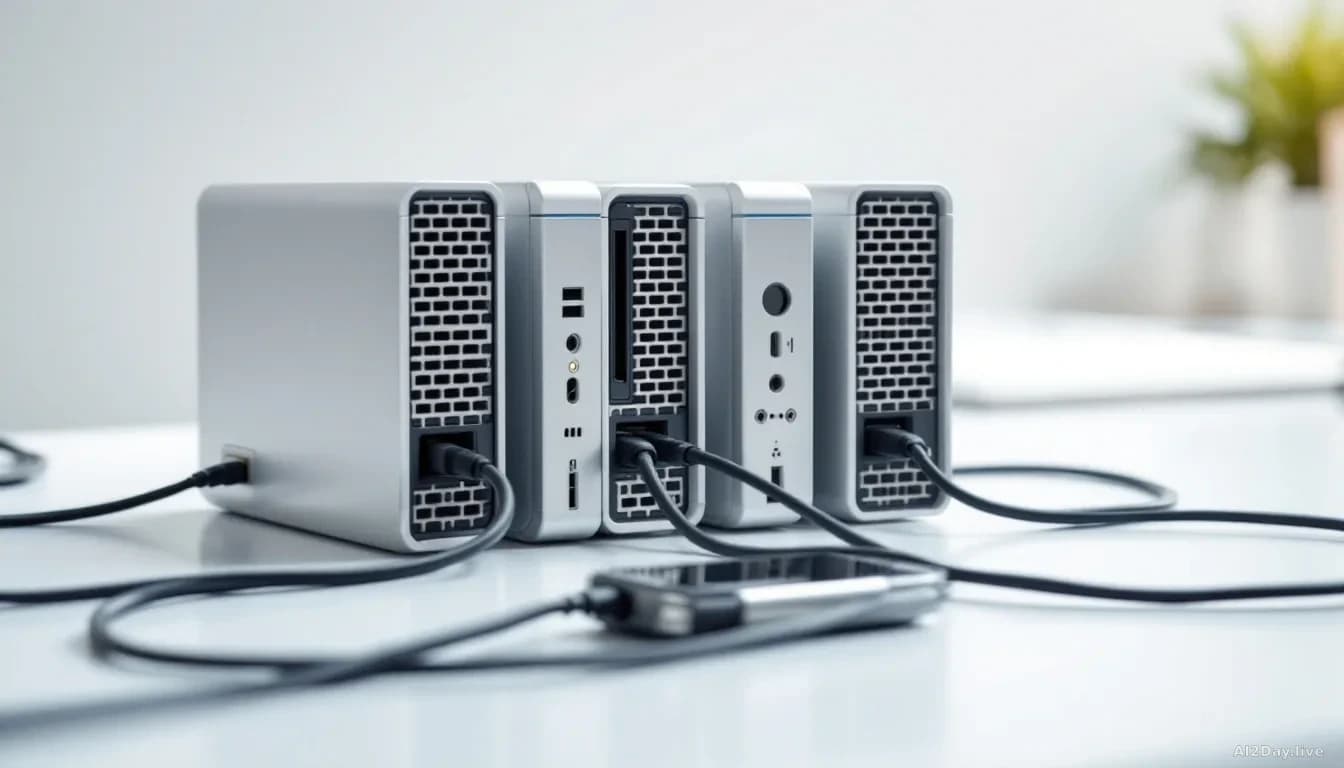
- A cluster of four Mac Studio computers with Apple's M5 Ultra chip runs Muse Spark Open, an 816-billion-parameter AI model, at over 36 tokens (individual word-pieces) per second, comfortably above average human reading speed.
- Apple ML Research benchmarks show the M5 Ultra chip processes the first piece of a long response up to 4.6 times faster than the M3 Ultra, thanks to dedicated matrix-multiplication hardware built into the GPU.
- Two Mac Studios connected by Thunderbolt 5 cables can split a model too large for one machine, using a low-latency network driver introduced in macOS 26.2.
- Peak power draw during heavy AI work stays at roughly 300 watts per Mac Studio, less than a common electric kettle.
- The MLX Community on Hugging Face hosts pre-converted model weights ready to run with these tools, including a four-bit compressed version of Muse Spark Open at roughly 493 gigabytes.
Not long ago, running a frontier AI model meant renting time on a data-centre server the size of a shipping container. On Thursday, Apple ML Research published benchmarks showing that four Mac Studio desktops, connected by the same Thunderbolt cables you might use for an external hard drive, can do the same job.
The star of the test is Muse Spark Open, an 816-billion-parameter model. A "parameter" is one of the billions of numerical dials an AI model adjusts during training; more of them generally means more capable reasoning. Muse Spark Open is what engineers call a mixture-of-experts model: rather than firing every parameter at once, it routes each query to a specialised sub-group, so only about 42 billion parameters are active at any moment. That cuts the computing load sharply, but the raw storage requirement in its full precision still exceeds 1.6 terabytes, far beyond any single Mac.
How do you fit a trillion-parameter model on a desktop?
You don't, on one machine. Apple's answer is to split the work. In pipeline parallelisation, one Mac Studio handles the first half of the model's processing layers and passes the result to a second machine, which handles the rest. A more demanding scheme, tensor parallelisation, spreads each layer's calculations across several machines simultaneously.
Both methods rely on a fast connection between computers. MacOS 26.2 introduced an RDMA (Remote Direct Memory Access) driver over Thunderbolt 5. RDMA lets one machine read or write directly into another machine's memory without waking the second machine's main processor, cutting delays sharply. Apple's open-source MLX framework, version 0.30.1 and later, uses this link through a communications layer called jaccl (pronounced "jackal"). Connecting two Mac Studios with two Thunderbolt cables doubles the available link bandwidth.
The MLX Community on Hugging Face already hosts pre-converted model weights ready to run with these tools, including a four-bit compressed version of Muse Spark Open that shrinks the memory footprint to roughly 493 gigabytes, small enough for a two-machine setup. When Jun Kim joined Hugging Face in September, we noted that his move put serious muscle behind open-source local AI on Apple Silicon; today's benchmark is the clearest sign yet of what that investment is producing.
Does the new M5 chip make a real difference?
Yes, especially when the model is processing a large block of text at once. The M5 Ultra's GPU includes dedicated neural accelerators, specialised circuits for the matrix-multiplication calculations that AI models do constantly. At a context window of 65,536 tokens, the M5 Ultra reaches time-to-first-token (how long before the model starts generating any reply) 4.6 times faster than the M3 Ultra.
Raw generation speed tells a similar story. The M5 Ultra's memory bandwidth of 1.2 terabytes per second, up from 819 gigabytes per second on the M3 Ultra, drives a 1.6-times improvement in tokens-per-second output. A single Mac Studio with 512 gigabytes of RAM handles both smaller models in the benchmark: Mistral Medium 3.5 (128 billion parameters) and Qwen 3.8 (27 billion parameters), no multi-machine setup required.
Power consumption stays modest. The M5 Ultra peaks at around 300 watts under heavy AI load, less than a common electric kettle draws.
What this means in practice: a privacy-conscious developer or a small research team can run a frontier-class model on a desk, with no cloud subscription and no data leaving the building. The barrier that's falling isn't speed or memory any more. It's the assumption that serious AI work belongs in a server room. When the hardware is this accessible, the next pressure point shifts to software: who builds the tools that let ordinary users actually direct these models toward useful work, rather than just benchmarking them.
Common questions
Do I need four Mac Studios to try this?
No. The two smaller models in Apple's test, Mistral Medium 3.5 and Qwen 3.8, run comfortably on a single Mac Studio with 512 gigabytes of RAM. Only Muse Spark Open, the near-trillion-parameter model, needs multiple machines.
Is the software free to use?
MLX is open-source and free. Pre-converted model weights are hosted on the MLX Community page on Hugging Face at no charge, though you need compatible Apple Silicon hardware to run them at the speeds described here.