Americans are souring on AI faster than the industry can spin it
From data centers in backyards to a landmark social media settlement, public anger at big tech is showing up in election campaigns, boardrooms, and IPO filings.
Key points
- More than half of Americans say they're more concerned than excited about AI in daily life, up from 37% in 2021, according to Pew Research Center.
- Roughly $130 billion worth of data center projects were blocked or delayed in the first quarter of 2026 alone, per Data Center Watch.
- Meta agreed to pay up to $17 billion to settle a bipartisan lawsuit over harm its social media apps caused children and teens.
- Over 75% of young adults in a CNBC Generation Lab poll said they don't trust Anthropic CEO Dario Amodei to act responsibly.
- Anthropic and OpenAI are each valued at close to $1 trillion and preparing for public stock offerings where AI backlash is expected to appear as a formal risk factor.
The mood in America toward the technology industry has shifted from skeptical to openly hostile. Protests outside local government buildings, engineers testifying against their own employers, and a landmark court settlement, all in the space of a few months, paint a picture of a public that's stopped giving Silicon Valley the benefit of the doubt.
The anger runs on two tracks. One is about AI, the technology behind tools like ChatGPT and Claude that companies predict will reshape work and the economy. The other is about social media, and the damage platforms like Instagram and Facebook allegedly did to children. Both tracks converged this week.
What exactly has people so angry?
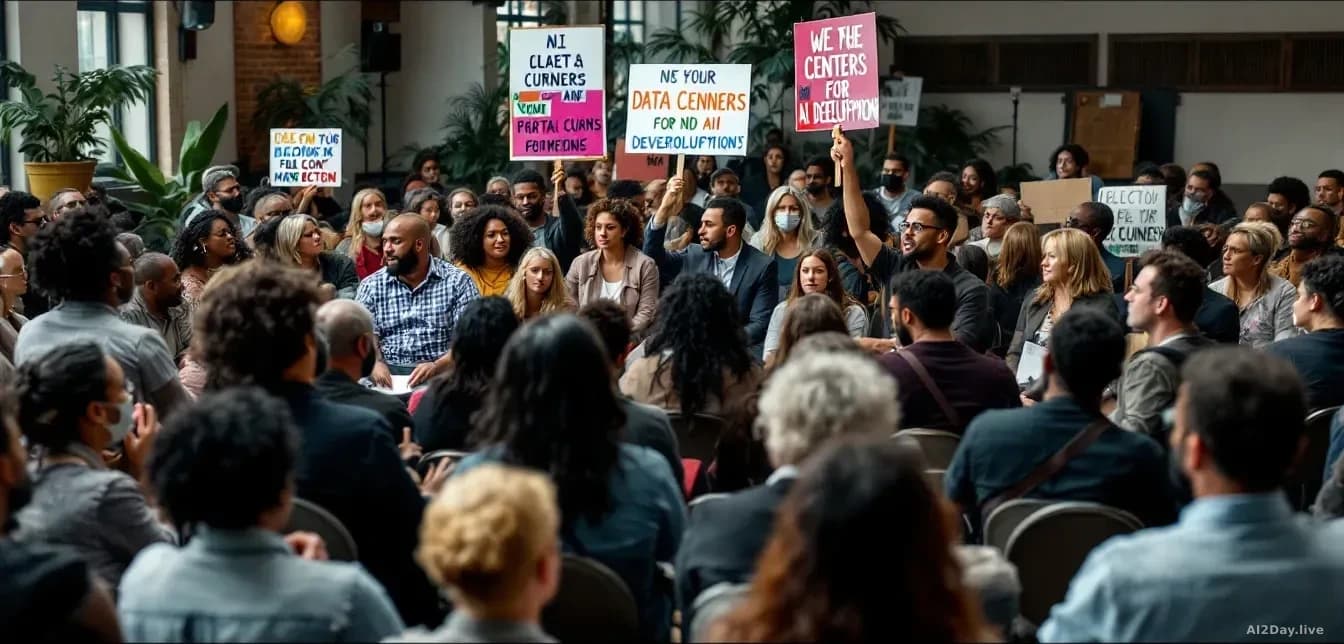
For AI, the flashpoint is physical: data centers, the warehouse-scale buildings packed with specialised computer chips that train and run AI systems. Residents in Arizona and Michigan have shown up by the hundreds to oppose new facilities, citing higher electricity bills, water consumption, noise, and the loss of farmland. Pennsylvania communities have seen the same.
Roughly $130 billion worth of projects were blocked or delayed in just the first three months of 2026, according to Data Center Watch. That figure nearly matched the $156 billion disrupted across all of 2025. A coalition called Stop Data Centers is now pushing for a full national pause on new builds.
In Seattle, Amazon engineers went a step further. They testified before the city council in June, calling for tighter regulation and criticising their own company's use of what they called "dirty energy" at some sites.
Should ordinary people be worried about what comes next?
The tension is real and spreading. Opposition to data centers has become a campaign issue in this year's midterm elections, just two months away. The National Republican Senatorial Committee privately flagged the issue as a "sleeper issue" for the entire election cycle, according to a memo reported by CNBC. As we noted when a Florida county voted unanimously to halt new data center construction in August, the politics here don't break along familiar partisan lines.
On the social media side, Meta agreed this week to pay up to $17 billion to settle a lawsuit brought by a bipartisan group of state attorneys general who argued the company knowingly harmed children. The settlement includes a default two-hour daily screen limit for teenagers, silenced notifications during school hours, and stronger parental controls.
Trust in the executives running major AI companies is particularly low among younger adults. A CNBC Generation Lab survey of 18- to 34-year-olds found that more than 75% don't trust Amodei to act responsibly. Around 70% said the same about OpenAI CEO Sam Altman and Meta CEO Mark Zuckerberg.
| Metric | Figure | Source / Date |
|---|---|---|
| Americans more concerned than excited about AI | More than half | Pew Research Center, 2026 |
| Same figure in 2021 | 37% | Pew Research Center, 2021 |
| Data center projects blocked, Q1 2026 | ~$130 billion | Data Center Watch |
| Data center projects disrupted, all of 2025 | ~$156 billion | Data Center Watch |
| Young adults who distrust Amodei | 75%+ | CNBC Generation Lab |
| Meta settlement value | Up to $17 billion | Bipartisan AG coalition, 2026 |
Amodei addressed the distrust directly in a post on X earlier this month. "I think it is fundamentally a crisis of trust," he wrote, adding that people "always suspect that we are cooking up some new way to screw them over."
Sarah Myers West, co-executive director of the AI Now Institute, a research organisation that studies the social impact of AI, told CNBC the industry can't treat public anger as a marketing problem to smooth over. "Treating it as a PR problem," she said, "would be tremendously misguided."
The beat reporter's honest read: the numbers here are harder for the industry to dismiss than previous waves of criticism. When distrust of AI executives runs above 70% among the adults who'll be using these products for decades, no IPO roadshow fixes that. Watch whether Anthropic's prospectus treats backlash as a boilerplate legal disclaimer or as something that shaped the actual business strategy.
For parents of teenagers: the Meta settlement's new protections roll out across Facebook and Instagram, so it's worth checking the parental control settings in both apps. On data centers, local planning meetings are where opposition is having the most impact.