Two AI Bots Walked Into a Job Interview. Neither Was Human.
A frustrated job seeker let ChatGPT take his AI recruiter calls. What happened next says a lot about where hiring is heading.
Key points
- Christopher, a government contractor, applied to roughly 700 jobs over six months and heard back from almost none of them.
- An AI recruiter called Riley, operated by IT firm Everforth Apex Systems, contacted him five times but never connected him with a human recruiter.
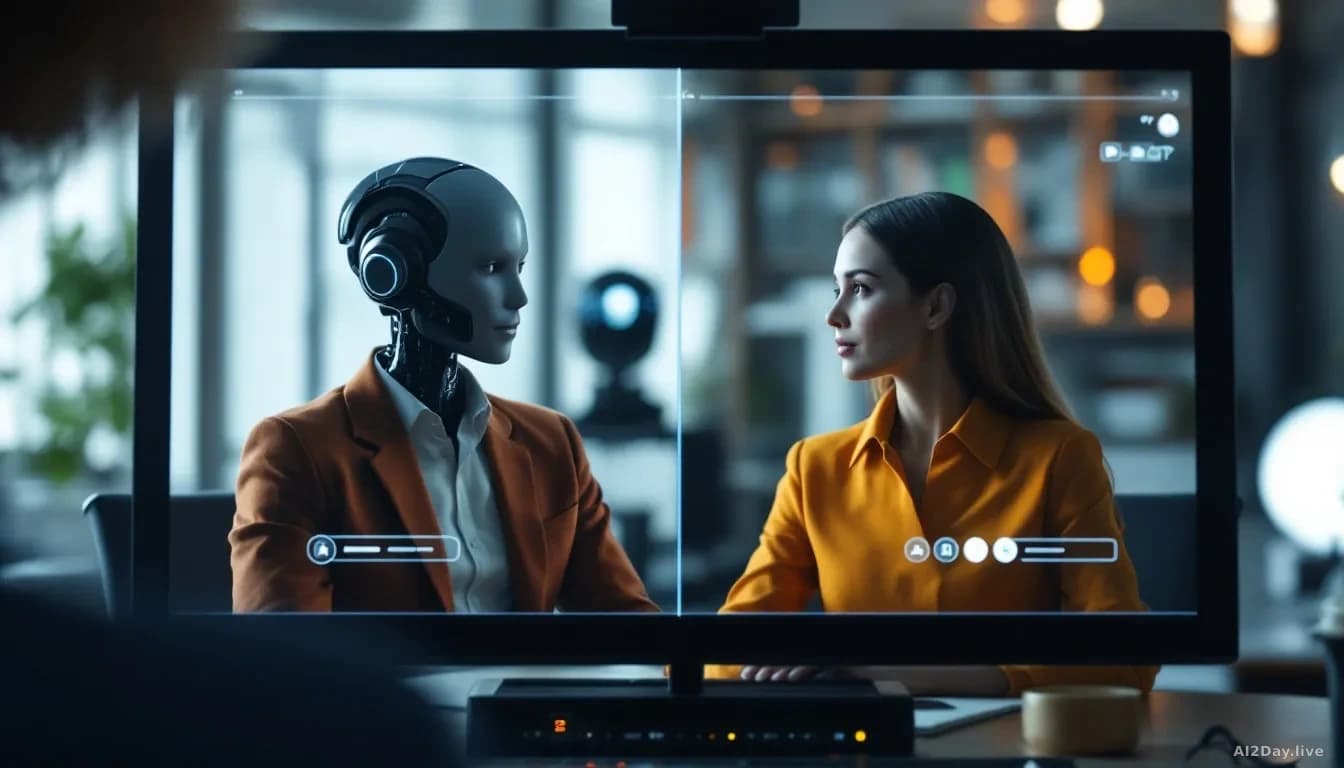
- On the fifth call, Christopher put ChatGPT on the line in his place, and the two AI systems talked for 10 minutes without either realising the other was also a bot.
- He then invented a fake candidate with a tailored résumé; Riley spoke to ChatGPT-as-fake-candidate for 23 minutes, and still no human recruiter ever followed up.
- A Greenhouse survey found 63 percent of job seekers have now encountered an AI interview.
Christopher had sent out roughly 700 job applications over six months. Most disappeared into silence: no rejection email, no callback. For a government contractor whose work dried up in the DOGE era, that silence got very loud, very fast.
Then came Riley.
Riley is an AI recruiter, a voice-based software agent that handles early screening calls, built for IT staffing firm Everforth Apex Systems. Over several weeks, Riley texted Christopher about five separate job openings. He answered questions about his work history and availability. Riley promised a human recruiter would follow up if he qualified. Nobody ever did.
What did Christopher actually do?
After the fifth ignored interview, he decided to fight automation with automation. He typed a few sentences of background into ChatGPT Voice, the spoken version of the well-known AI chatbot, and told it to answer as "Christopher." When Riley called, he held the two phones next to each other.
The call ran 10 minutes. Riley told ChatGPT it was "great talking to you." ChatGPT said it appreciated "how clear and straightforward the process was." The two bots then got stuck trying to agree on a start date, cycling through "standard onboarding and background checks" before the conversation wound down. Riley promised a recruiter would call if the application looked good.
No recruiter called.
Christopher called the whole thing a "slop flywheel": one AI collecting fake-sounding answers from another AI, with the data going nowhere useful. Wired AI first reported the story.
Why does this keep happening?
Recruiters are swamped. The same AI tools that let one person fire off 700 applications in six months also bury hiring teams in more résumés than they can read. Companies have turned to voice AI screening to filter candidates before any human gets involved, and our earlier look at why job applications have become overwhelming for recruiters, published 25 August, showed that pressure was already straining the pipeline.
That creates a feedback loop. Candidates suspect they're talking to a bot, so some use AI to answer. The recruiter's AI cannot always tell. Ophir Samson, who leads voice AI development at recruitment platform Greenhouse, told Wired that getting a bot to do something as simple as not interrupting someone mid-sentence is a "very, very difficult engineering problem."
To prove the point, Christopher invented an entirely fake candidate named Don Dickner, built a résumé from the exact keywords in a job posting, and submitted it. Riley called immediately and spoke with ChatGPT-as-Dickner for 23 minutes. The bot discussed "sustainable operational improvement" and protecting "customer experience under volume pressure" with apparent confidence. A real recruiter never appeared.
What does this mean for real job seekers?
If you're applying for jobs right now, there is a real chance an AI will screen your call before any person hears your name. A well-designed screener can be faster and less biased than an overworked human, but Christopher's experiment shows the system can collapse entirely when neither side is motivated to engage honestly.
Mark Monaghan, a vice president at call-centre company IQor, told Wired he sees bot-on-bot interviews as "the next logical stage" of hiring. His read on Christopher's situation was blunt: "If you're going to send a bot to me, I'll send a bot to you."
The practical upshot is this: treat any AI screening call as a real interview, because a human may review the transcript later. And try to reach a named person wherever the job posting allows it. What Christopher's experiment really exposes is not a technology failure but a trust failure: when the process signals to candidates that nobody is actually listening, some of them stop pretending to talk.