Why AI restaurant menus look weirdly perfect and slightly wrong
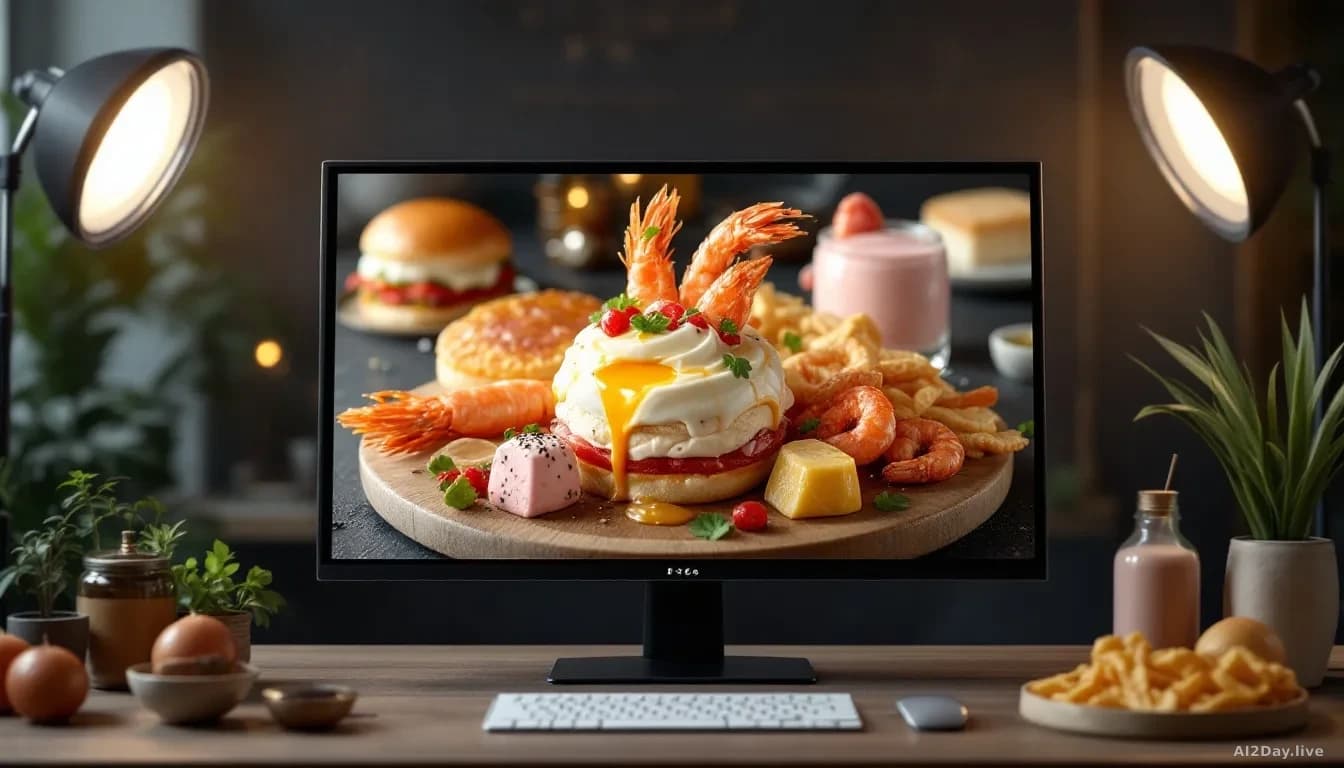
Shrimp curling into themselves, impossibly glossy buns, ice cream scoops so round they look engineered. There is a real technical reason AI food illustrations give you the creeps.
Key points
- AI-generated restaurant menus are spreading, and diners report an instinctive sense of unease when they see them.
- Researchers at the University of Duisburg-Essen found that near-realistic AI food images trigger more disgust than obviously fake ones, a psychological effect called the "uncanny valley."
- Repeated editing of an AI-generated image pushes it toward an over-smoothed, hyper-symmetrical look with each revision.
- When AI models train too heavily on their own outputs, image quality degrades through a process researchers call "convergence."
- The same forces that make a burger look surreally perfect online are eroding trust in photos and video as evidence.
You walk into a cafe, pick up the menu, and something feels off. The bagel sandwiches look almost edible but not quite. Too smooth, too symmetrical, every sesame seed placed by a machine that has never been hungry.
You are not imagining it.
What is actually happening to these images?
AI image generators learn from enormous libraries of existing photos and illustrations, and most food photography is already styled to look better than reality. Think of a McDonald's commercial where a prop designer spends an hour stacking a single burger. The AI absorbs millions of images like that and treats them as normal.
The result is what Alex Lisle, chief technology officer at Reality Defender (a startup that builds tools to detect AI-generated content), described to TechCrunch as "an alien trying to make a pizza without understanding its core principles." The AI knows what ingredients should be present. It has no idea what it feels like to eat one.
Diffusion models, meaning software that builds images from statistical patterns rather than actual perception, are trained heavily on commercial food photos from chain restaurant menus. Lisle put it bluntly: "A lot of this stuff looks like a Chili's menu from 2015, and there's a reason for that. That was the corpus of work from which the models drew their function."
Why do the images keep getting stranger?
Editing makes it worse. Each time a restaurant asks the AI to tweak a menu, adjusting a price here or swapping an item name there, the images drift further from reality. A user on X demonstrated this by generating a menu in ChatGPT, then requesting 100 successive edits and watching the food become rounder, shinier, less appetising with every pass.
Lisle calls the underlying mechanism "convergence." When AI models feed too much of their own output back into their training data, outputs narrow toward a single heavily averaged aesthetic. Everything starts to look like the most statistically average version of "food." It isn't quite "model collapse," where a system breaks entirely, but Lisle compared it to a slow inbreeding effect where realism and variety bleed away over generations.
Lee Rainie, director of the Imagining the Digital Future Center at Elon University, frames it differently: "What AI is known to do both in images and language is to shave off the edges." The optimisation is for pleasingness, not accuracy.
Should diners trust their instincts?
Yes. Human unease with these images is not just aesthetic squeamishness. Research from the University of Duisburg-Essen in Germany found that AI food images land in what psychologists call the "uncanny valley," a zone where something looks almost real but not quite, and that near-miss triggers more disgust than an obviously fake cartoon would.
Restaurant owners should take note: customers notice, even when they can't say why. Lisle points to a wider concern beyond the dinner table. We've been tracking how AI-generated imagery erodes trust across contexts, from politicians posting AI selfies to faked animal rescue footage; a slightly-too-perfect shrimp on a takeaway menu is the same problem at a smaller scale. Photographs and video have long been the gold standard in courtrooms and newsrooms. That standard is cracking.
Common questions
Can you tell for certain whether a menu image is AI-generated?
Not always at a glance. Look for over-smooth textures, ingredients that curl impossibly into themselves, or a hyper-symmetrical arrangement that no kitchen could replicate. Specialist detection tools exist but aren't foolproof.
Do restaurants know their menus look strange?
Many don't. They use an AI tool to create a menu cheaply and then edit it repeatedly, unaware that each revision nudges the images further from reality.
Is AI food photography always bad?
Not necessarily. A skilled designer using AI alongside human oversight and real food as a reference can produce convincing results. The problems arise when the AI iterates alone.