Train the Robot in a Fake World First, Then Send It Into the Real One
Before a robot ever touches a warehouse shelf or a factory floor, it can spend thousands of hours learning inside a computer-built copy of that environment. Here is why that matters.
Key points
- The global robotics market is forecast to grow at 19.6% per year from 2026 to 2036, according to Future Market Insights.
- A forklift perception model trained with synthetic data and NVIDIA Cosmos reached 99.5% precision on real warehouse footage after environment-specific tuning.
- A simulator-only model, with no real-world calibration, reached just 49.4% recall on the same real-world data.
- Virtual commissioning, testing a robot's software connections before physical installation, can cut deployment time by 30% to 50%.
A robot that works perfectly in testing can still fail on the job. Packaging changes. A pallet sits at a slightly different angle than any training photo showed, and that small difference is enough to stop a production line.
That gap between a controlled test and messy reality is why robotics engineers are turning to what they call "virtual gyms."
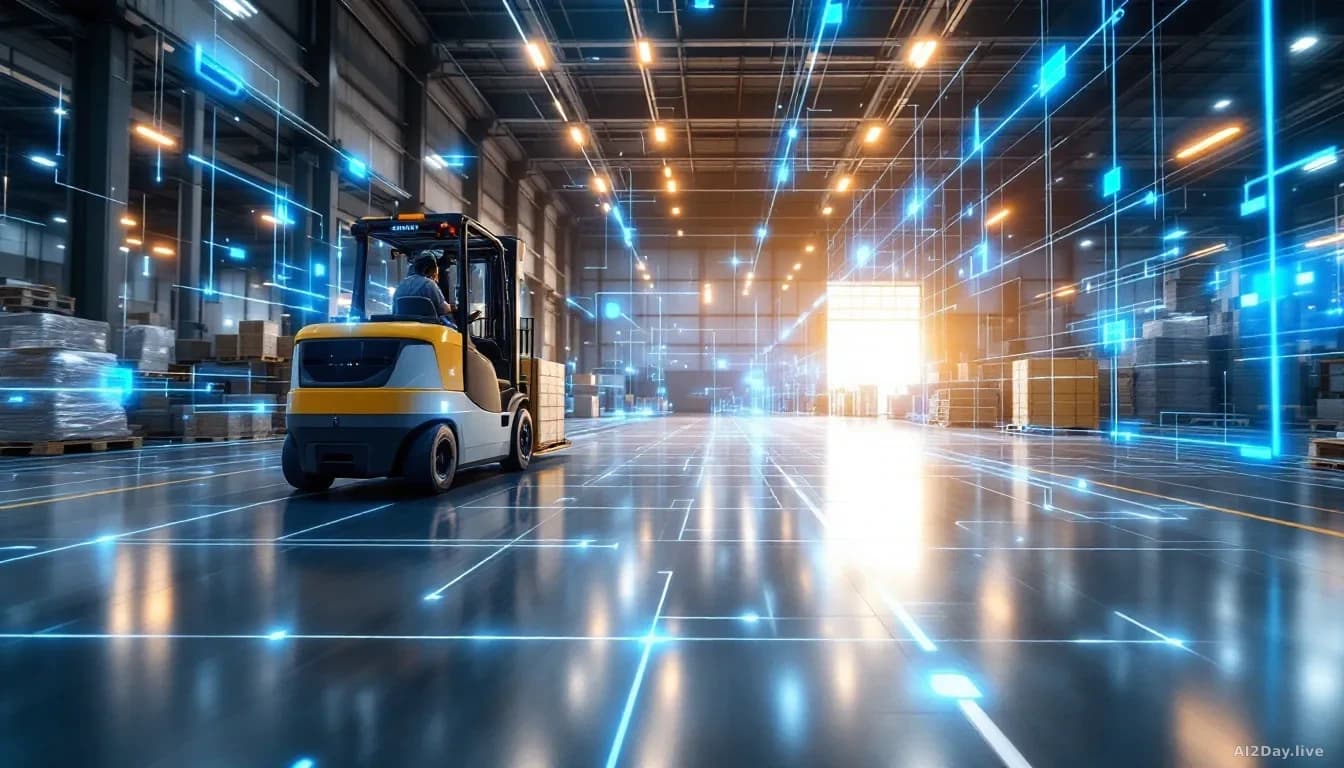
A virtual gym is a detailed computer-built replica of a real working environment: a warehouse aisle, a factory floor, a loading dock. Inside it, a robot can attempt tasks thousands of times, fail and recover before a single physical trial takes place. No broken equipment, no halted production, no safety incidents.
The Robot Report covered the approach in depth, drawing on work by software engineering firm SoftServe, and the numbers are striking.
Does this actually close the gap between simulation and real life?
Not entirely, but it closes it far more than simulation alone. SoftServe's team built a system for Toyota Material Handling Europe to improve how forklifts recognise pallets in warehouses, where labels, floor textures and lighting vary constantly. A model trained purely inside a simulator scored 49.4% recall, meaning it missed roughly half the pallets in real footage. After the team added synthetic images generated by NVIDIA Cosmos (a tool that creates photorealistic fake training images) and then calibrated those images to match the actual client site, recall climbed to 92.8% and precision hit 99.5%.
Synthetic data isn't a replacement for real-world footage. It's a way to make real footage go further, by filling in the rare or dangerous situations that almost never appear during normal operations: a dropped object, a sensor glitch, a near-miss. These events matter enormously for safety but happen too seldom to train on directly. Virtual gyms generate them on demand.
The right level of detail inside the gym depends on the job. A robot navigating a warehouse aisle needs accurate maps of human foot traffic and pallet positions; a robot filling liquid containers needs accurate fluid-dynamics physics. Too much detail in the wrong area wastes time, and too little in the right area produces a robot that passes simulation and fails reality.
Connecting the simulation to the robot's actual control systems matters just as much as the physics. When a robot moves from a virtual gym to a real site, its software must talk correctly to safety systems and fleet management tools. Testing those connections virtually, a process called virtual commissioning, cuts physical setup time by 30% to 50% in industrial settings, based on SoftServe's figures.
AI2Day first reported on robot-training methodology on 13 July 2026 in "The robotics programme that bans adults from touching the robots", which looked at how early coding education shapes the people who will eventually build these systems. The pipeline from student programmer to warehouse deployment is shorter than it looks.
For ordinary people, the practical upshot is this: robots arriving in warehouses and public spaces over the next few years will have spent far more time training in fake environments than real ones. When that training's done well, the robot on site is less likely to make costly or dangerous mistakes on day one.



