The robotics programme that bans adults from touching the robots
Botball gives every student the same box of parts, teaches real coding languages at elementary-school age, and bars adults from the competition floor. Here is how it works and why girl participation is notably higher than the industry norm.
Key points
- Botball, run by the KISS Institute for Practical Robotics (KIPR), gives every competing team worldwide an identical kit of parts so that budget cannot determine who wins.
- The Junior Botball Challenge lets up to five students simultaneously program different sections of code on a single robot, replacing the old one-student-one-task model.
- Girls make up more than 55 percent of participants in Junior Botball Challenge classrooms, compared with roughly 30 percent in traditional competitive robotics programmes, according to KIPR.
- Every Botball robot must run fully on its own, starting only when a light sensor fires and stopping automatically after two minutes.
- KIPR's Botball Academy lets students test their code in a physics-based virtual simulator before building anything physical, so mistakes cost nothing.
Most school robotics competitions carry an unspoken handicap. Wealthier schools buy better motors, better sensors, and more coaching hours. Botball, a programme run by the KISS Institute for Practical Robotics (KIPR), a non-profit based in Oklahoma, strips all of that away.
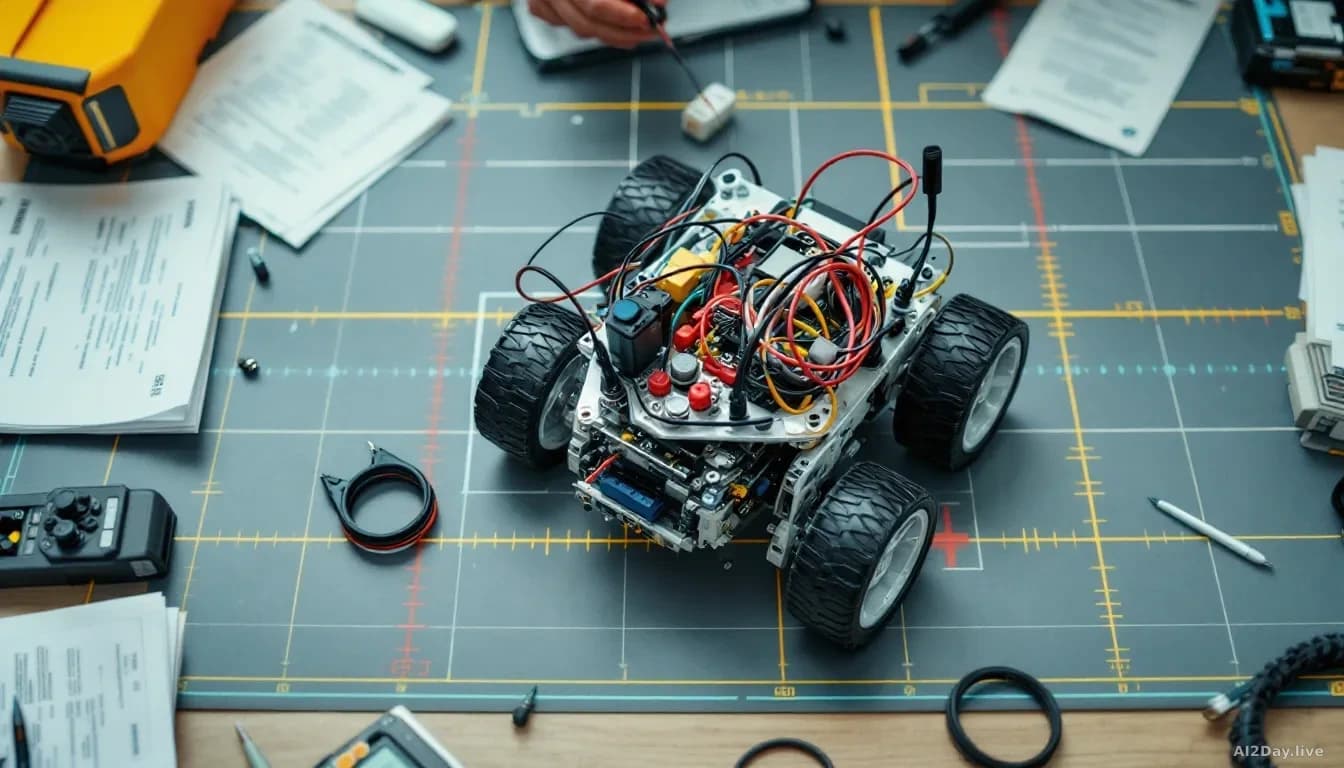
Every team on the planet receives the same sealed box of components. No upgrades, no substitutions. "Everybody in the world gets the same box of parts," KIPR executive director Steve Goodgame told The Robot Report. "You can't buy better parts, can't make better parts. Adults don't touch the robots when they come to the competition. Adults are out of the pits."
That last rule matters more than it sounds. Competitions that rely on adult mentors coaching from the sidelines teach students a different lesson: that someone else will rescue them when things break. Botball removes that safety net deliberately.
Students also write real code. Not the simplified drag-and-drop block coding common in elementary classrooms, where you snap coloured tiles together to give instructions. Botball teaches C and Python, the same text-based languages used by professional software engineers. Goodgame said a small pilot showed younger students picked this up faster than expected, because children learning language for the first time are already primed to absorb new symbol systems.
Why do more girls take part?
Because Botball runs inside the regular school day rather than as an after-school club, it reaches students who cannot stay late, a group disproportionately affected by social and logistical barriers. The result is striking. Girl participation sits above 55 percent in Junior Botball Challenge classrooms, against around 30 percent in traditional competitive robotics.
The Junior Botball Challenge also redesigns the team structure. A single controller allows up to five students to each own a different slice of the robot's behaviour, running simultaneously. Nobody is stuck holding a clipboard while one classmate does all the real work. It's the kind of structural fix that demographic statistics alone rarely produce.
Botball Academy, KIPR's free virtual simulator, a software environment that mimics real physics so students can watch their code fail before anything breaks, rounds out the toolkit. Teams iterate quickly, at no cost, then move to hardware once the logic is sound.
Schools interested in the 2025 to 2026 competition schedule can find details on the KIPR website.



