The Robot Dog That Works the Night Shift
More than $23 billion flowed into physical AI and robotics in 2026 alone. A growing slice is going toward security robots that can spot threats before a human guard ever gets the call.
Key points
- Over $23 billion was invested in physical AI and robotics in 2026, according to The Robot Report.
- A Jaguar Land Rover cyber-physical attack last year halted production and cost the British economy an estimated $2.5 billion.
- Foxlink and Luminys demonstrated a quadruped security robot at GTC Taipei 2025, built with Nvidia and SYNC technology.
- Security robots are already active in hospitals, shopping malls and education campuses worldwide.
- The open question isn't whether these machines will spread: it's who owns the data they collect.
The robot dog has a job now. Not a novelty job. A night-shift job.
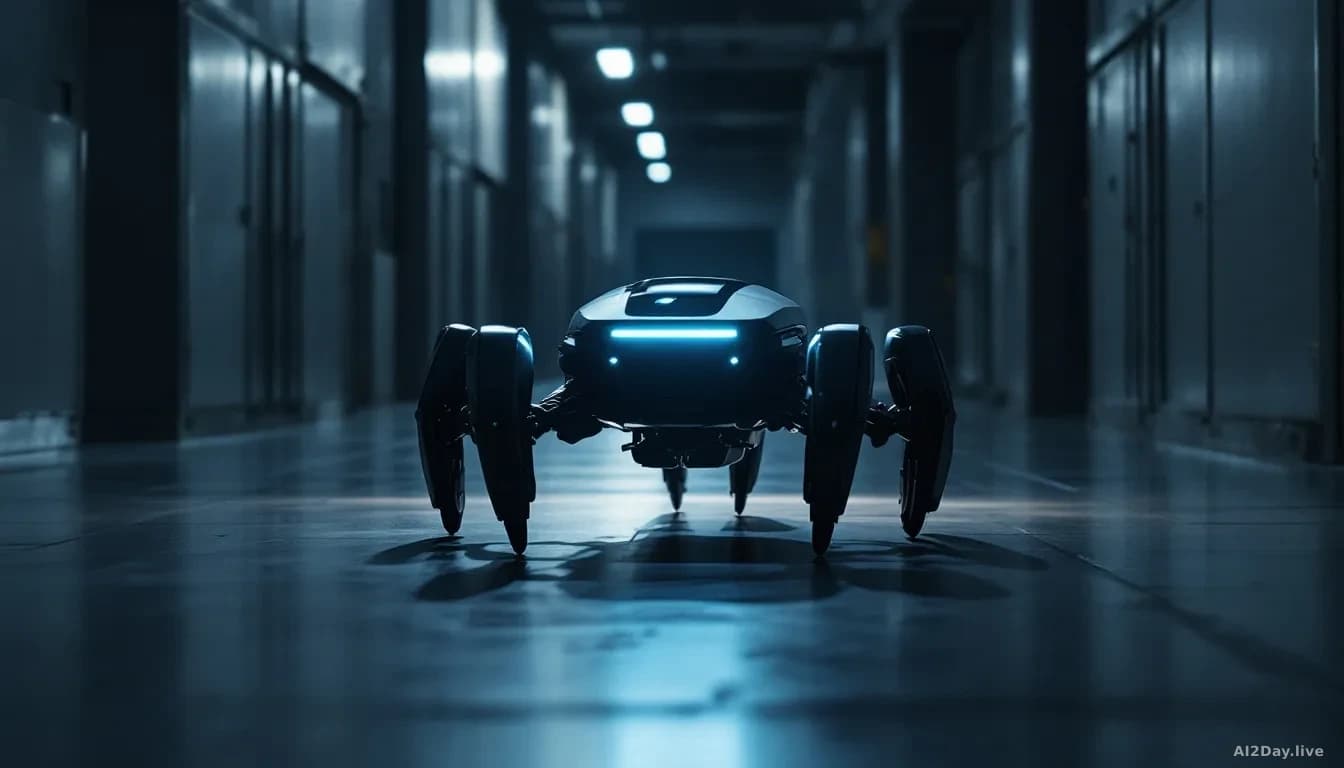
At GTC Taipei 2025, Foxlink and Luminys showed a four-legged patrol robot built around physical AI, the term the industry uses for AI systems that perceive and act in the real world rather than just on a screen. Packed with smart sensors and connected to Nvidia and SYNC technology, the machine walks a facility, spots anything unusual and flags it without waiting for a human to notice first. That shift from reacting to events toward catching them early is the whole point.
Why is physical security suddenly such a big deal for AI?
Legacy hardware is part of the problem. Older cameras and access-control systems can only tell you what already happened. Connecting them to a central platform helps, but it also creates a single point of attack.
That vulnerability became very real with the Jaguar Land Rover incident reported last year. Stolen login credentials, reportedly obtained through social engineering (tricking employees into handing over access), let allegedly state-sponsored actors into the carmaker's IT network. Production lines shut down entirely, costing the British economy an estimated $2.5 billion. One digital door left open, one factory floor silenced.
Geopolitical tension and tighter supply chains are widening that gap. Security teams protecting data centres and manufacturing plants face threats that move faster than any static camera grid can track.
What does an AI-powered security robot actually do?
Think of the Foxlink-Luminys machine as a mobile sensor node with a reasoning engine attached. Its onboard AI is built on large language model (LLM) technology, the same class of software behind chatbots like ChatGPT, and it continuously processes what its sensors pick up. A door propped open at 2 a.m. Gets flagged. An unusual heat signature near an electrical cabinet gets logged and an alert goes out. Each patrol teaches the system a little more about what normal looks like, which matters because static systems learn nothing.
Robots can also bridge old and new. Rather than ripping out legacy hardware, a patrol unit can integrate with existing cameras and access controls, giving older infrastructure an AI upgrade without a full replacement.
Should ordinary workers be worried?
Not in the way the headlines usually suggest. These systems are designed to surface patterns for human review, not to make final decisions. A robot flags; a person decides.
That framing matters for liability too. We covered the accountability gap directly in our 30 September story on robot safety frameworks, which found researchers pushing hard for clearer rules before autonomous systems take on more frontline roles.
The pace of deployment is real. Patrol robots are already running in hospitals, malls and education campuses. Our October story on ANYbotics showed a robot turning a 2 a.m. Gas alert into a work order before dawn, precisely the overnight gap these machines are built to fill.
The honest watch item: who owns the data those robots collect, and what rules govern how long it's kept.
Common questions
Do these robots replace security guards?
No, at least not yet. Current deployments position them as an extra layer, handling continuous patrol and anomaly detection while human guards handle response and judgement calls.
What happens if the robot itself gets hacked?
That's an open and active question. Connecting any device to a network creates exposure, and security researchers are already treating patrol robots as a target worth studying.