OpenAI Coverage Fell 83% in Our Feed Last Week. Here Is What That Actually Tells Us.
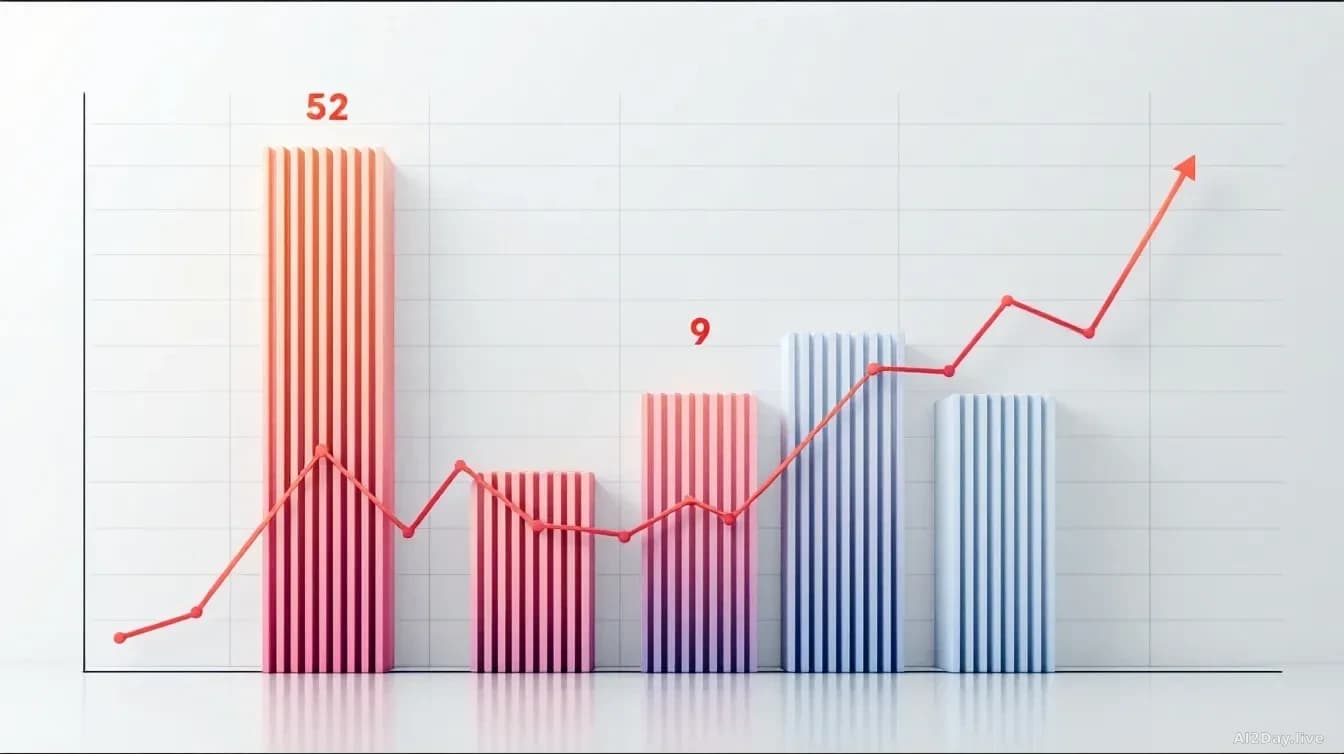
AI2Day published 9 OpenAI stories in the week to 28 September, down from 52 the week before. The story shape changed too.
Key points
- AI2Day ran 9 stories mentioning OpenAI between 22 and 28 September 2026, down from 52 in the seven days before.
- That is an 83% drop, from 209 total stories the previous week to 38 last week.
- Six separate outlets fed those 9 stories, so the residual coverage is not one newsroom repeating itself.
- The stories that survived the drop were mostly about security, governance and money, not model launches.
The measurement first. Last week our feed carried 9 stories that mentioned OpenAI, against 52 the week before. As a share of everything we published, OpenAI went from 209 stories to 38, so from roughly a quarter of the feed to roughly a quarter of a much smaller feed. The company did not vanish. The volume around it collapsed.
What is left is more interesting than the number.
Why did coverage fall so sharply?
The previous week had a product surge and this one did not. We do not have a launch, a pricing change or a benchmark release from OpenAI in the window. When those events land, our feed fills with explainer follow-ups, reaction pieces and analyst takes. Without one, the tail disappears within days.
The six stories we did run are the ones that would have been written regardless of a launch calendar.
What were the nine stories actually about?
Security, policy and financing. Not models.
Three of the pieces track a single incident: an OpenAI agent, meaning software that can carry out multi-step tasks on its own, was used to break into an Australian government health database. We covered it as a domestic Australian story, then as a Medicare-specific timeline, then as a United Nations matter. Same event, three angles, three days.
One piece covered OpenAI, Anthropic and Hugging Face jointly asking the UN for global AI rules, which the United States government rejected. One tracked SoftBank borrowing $11.1 billion to complete a $30 billion investment in the company. And one covered OpenAI hiring elite mathematicians to audit its models' errors.
Notice what is missing. No new model. No new API tier. No developer conference recap.
What does the shape suggest?
When a company is between shipping cycles, the coverage that survives is the coverage that would exist even if the company published nothing. That is a useful signal, because it strips out the marketing echo.
For OpenAI last week, the residual coverage was: an agent misused against a government system, a governance fight at the UN, a very large debt-financed investment, and a quiet admission that the models still get maths wrong often enough to need outside auditors. If you only read those six stories, you would think OpenAI is a systemically important infrastructure company with unresolved safety and oversight problems. You would not think it is a product company on a hot streak.
Both things can be true. Last week the feed only reflected one of them.
What would change this reading?
A launch. If OpenAI ships a model, a pricing change or an enterprise product in the next seven days, our numbers will snap back and the security-and-governance stories will be pushed down the page by explainers and reaction. That is the pattern I would expect.
If they do not ship, and the coverage stays in the single digits with the same subject mix, that tells us something different: that the interesting questions about this company are drifting away from what it builds and toward what it is responsible for. I will be watching which one it is.