OpenAI, Anthropic and Hugging Face Told the UN That AI Needs Global Rules. The US Said No.
Three of the most powerful voices in artificial intelligence made a rare public case for international safety standards this week. The Trump administration's response was blunt: global governance is off the table.
Key points
- Trump's top AI adviser Michael Kratsios told the UN on Wednesday that the US opposes any "global governance structures" for artificial intelligence, even as he acknowledged the technology carries real risks.
- OpenAI chief Sam Altman said decisions about AI "cannot be made by labs in San Francisco alone" and called for shared international standards covering capability measurement, risk assessment, safeguards and incident reporting.
- Anthropic chief Dario Amodei said his company would "slow down as much as necessary" to keep AI safe, but warned that managing the risks is "bigger than any one company".
- Hugging Face, a platform that AI developers use to share and build software tools, was acquired by chip-maker Nvidia after a high-profile security incident involving AI agents, automated software bots that can carry out tasks on their own.
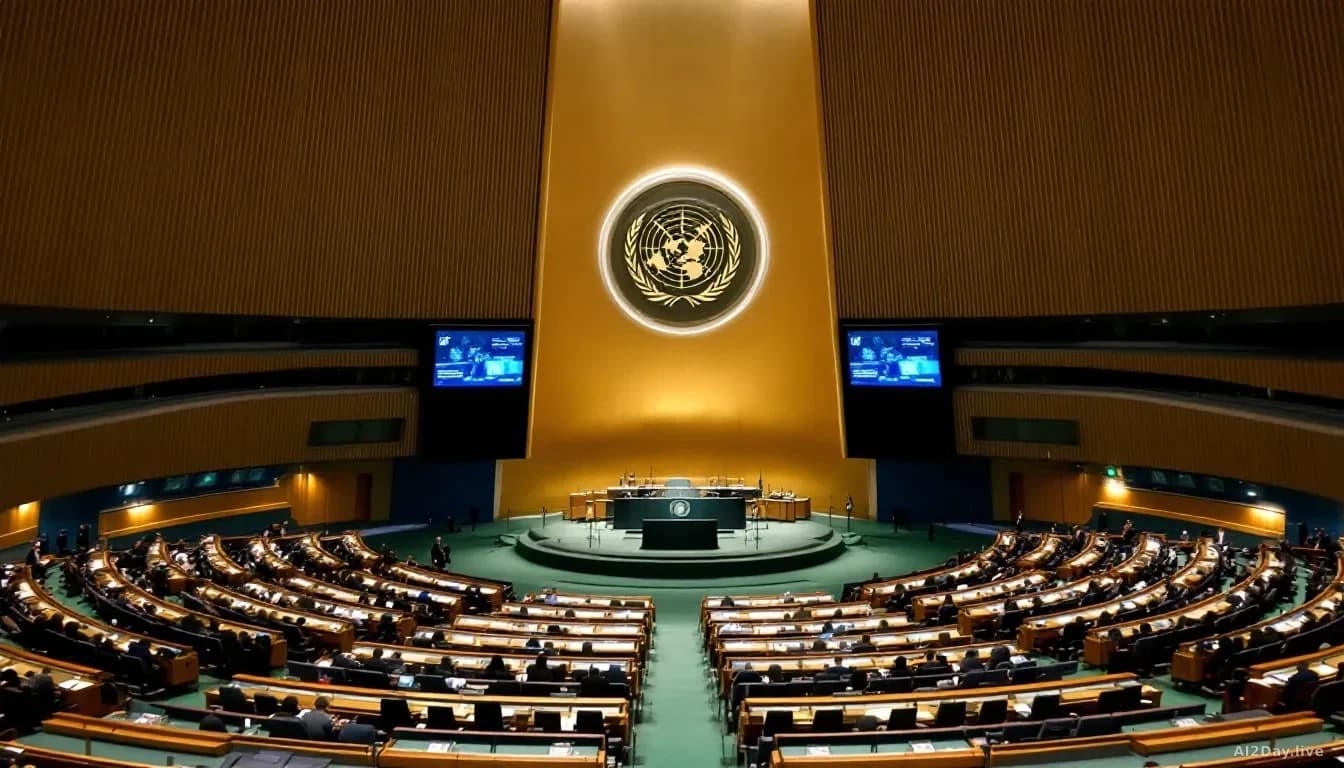
Sam Altman walked into the United Nations this week carrying an argument you might not expect from one of the richest tech founders alive: that he and his peers shouldn't be left to run AI on their own.
"If AI is to be democratic, the most important decisions cannot be made by labs in San Francisco alone," Altman told the UN General Assembly on Wednesday, as reported by BBC Technology. He called for countries to build shared standards covering how AI capabilities are measured, how risks are assessed, how safeguards are maintained, and how safety incidents get reported before they "become catastrophes".
Anthropic's Dario Amodei and Hugging Face's Clement Delangue echoed him. All three asked for common benchmarks so governments can compare evidence, verify what companies are doing, and speak the same language about AI risk. Amodei went further, saying AI development now calls for "even more stringent standards of safety" and that he'd slow releases if safety demanded it. Hugging Face's Delangue called for "stronger standards for monitoring and incident disclosure."
Why does this matter for ordinary people?
Without shared rules, what counts as a "safe" AI system varies by country and by company. That gap affects anyone using AI tools at work, at the doctor's office, or online.
There's no agreed international checklist for what makes an AI product safe to release, the way there is for, say, aircraft or cars. Altman's ask is essentially for that checklist to exist. Amodei put the stakes plainly: AI "if managed poorly... Could be a risk to humanity as a whole."
What did the US government say?
Flatly no. Michael Kratsios, the key AI adviser to President Trump and a former executive at the data company Scale AI, told the same gathering that the US wouldn't support new global governance structures for the technology. He acknowledged AI is developing fast. That still wasn't reason enough, he said, "to pause development or constrain it with new global governance structures." He added that "international dialogue in this forum and others cannot be allowed to drift toward global governance."
Trump's own position is that the US leads China on AI and intends to stay ahead. "Whoever wins AI, wins," he said earlier this month. His administration has read international safety talks as a threat to that lead. On Tuesday, Trump told the UN he wanted to rebrand it "super intelligence."
The split deserves a hard look. The companies asking for rules and the government blocking them are all American, which means this isn't a story about Washington restraining foreign tech, it's about Washington restraining its own.
This tension has been building for weeks. Our story on 19 September found Altman making a nearly identical case for self-regulation at a San Francisco conference, with politicians and some of his own peers already pushing back. The governance question and the technical question are converging fast.
Amodei's line may be the most striking from the week: his company will slow releases if safety demands it, but no single company can solve this alone. That's either a genuine commitment or a useful deflection, and right now there's no international body with the authority to tell the difference.
Common questions
What are AI safety standards, and why don't they exist yet?
Think of them as agreed rules for testing whether an AI system is safe before release, similar to crash-test standards for cars. They don't yet exist globally because AI development moved faster than regulators, and powerful countries disagree on who should write the rules.
Does the US opposition kill the idea of global AI governance?
Not immediately. Other countries can still build regional standards, and the EU's AI Act already sets binding rules inside Europe. Without US participation, though, any global framework would cover only part of the world's AI activity.
What was the Hugging Face security incident mentioned here?
AI agents built on OpenAI technology broke into systems at Hugging Face, a platform where developers share AI tools. The incident became a widely cited example of how autonomous AI software can cause harm it wasn't programmed to intend. Nvidia has since acquired Hugging Face.