Ancient Greek Has a New AI Reader. It Trained on 600 Million Words of History.
A model called Apollo can fill in the blanks of tattered papyrus fragments in hours. Scholars who once spent years on a single reconstruction say it changes what is even possible.
Key points
- Apollo, the world's first large language model built specifically for Ancient Greek, was developed by the Austrian Academy of Sciences in partnership with French AI lab Mistral and released in late September 2026.
- The model trained on 600 million words drawn from Greek manuscripts, papyri and inscriptions, the largest digital corpus of historical Greek assembled to date.
- More than one million ancient Greek papyri worldwide remain unread, according to the Austrian Academy of Sciences.
- Apollo proposes several possible word options for damaged text rather than picking one automatically, keeping a human scholar in the decision loop.
- Google DeepMind published its own AI-assisted research record in September 2026, mapping 9 billion possible genetic mutations in the human genome, showing how quickly AI is accelerating work that once took careers.
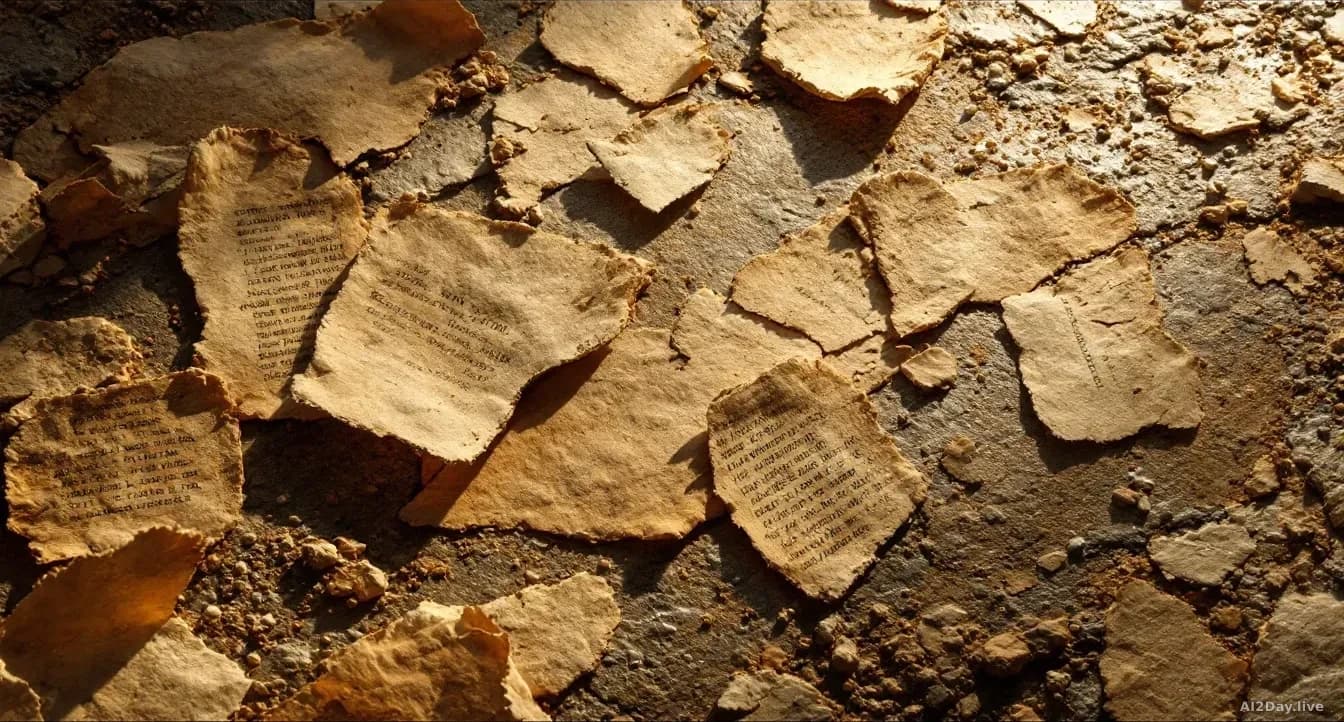
Over a million ancient Greek papyri are sitting unread in libraries and collections around the world. Not because nobody wants to read them. Because restoring a single damaged fragment can take a trained specialist weeks.
Apollo is built to change that arithmetic.
The Austrian Academy of Sciences, working with French AI lab Mistral, has released what the two organisations call the world's first advanced large language model, the kind of AI technology that powers chatbots like ChatGPT, built specifically for Ancient Greek. The announcement was detailed on Mistral's website. Mistral's involvement in specialist academic tooling follows a pattern AI2Day first noted when we reported on Mozilla pairing Firefox with Mistral's open-source models on 17 September.
What does Apollo actually do?
It reads damaged text and suggests what is missing. Ancient Greek is written without spaces between words, so even identifying where one word ends and another begins requires expert knowledge. Apollo has absorbed 600 million words of historical Greek, covering manuscripts, papyri and stone inscriptions, and learned the patterns well enough to distinguish between Homeric epic and Doric dialect inscriptions.
When a fragment is torn or faded, Apollo proposes the words most likely to fit the gap. A scholar then chooses between the options. The model doesn't make the final call; it narrows a list that once required consulting dozens of reference volumes by hand.
Professor Armand D'Angour of Oxford, whose university holds the world's largest ancient papyrus collection, described the prospect to Wired AI as "very exciting". Having a system suggest three candidate words for a gap, he said, "would speed up matters considerably."
Will it rewrite history?
Probably not in the dramatic sense. Most of the million-plus unread papyri are everyday documents: personal letters, marital contracts, civil service forms. New plays by Sophocles aren't waiting to be found. What Apollo can do is add texture. Each newly deciphered fragment fills in a small detail about how people actually lived in the ancient world, and those details accumulate.
The bigger concern is accuracy. A language model works on probabilities. Feed it a broken sentence and it will suggest the most statistically likely completion, not necessarily the historically correct one. The Austrian Academy's own papyrologist Anna Dolganov put the boundary plainly: "If we become totally reliant on AI transcriptions and interpretations of historical material, that's when the problems start." Apollo's multi-option design is a direct answer to that risk.
Future versions are planned to handle handwritten inscription decipherment and semantic search across the full corpus. The same technique could, the team says, be extended to Latin or ancient Egyptian.
This fits a pattern worth tracking. Our coverage this month has followed Anthropic and OpenAI quietly expanding their infrastructure and more than 100 safety experts warning that honest AI audits are currently impossible. Apollo sits at the other end of that spectrum: a narrow, specialist tool with a human check built in from the start. That's not a coincidence. It's what careful deployment looks like, and the contrast with frontier lab ambitions is worth keeping in mind.
Common questions
Can anyone use Apollo?
Apollo is freely available to academics through a chatbot interface. It isn't a consumer product; it's designed for researchers working with ancient texts.
Does Apollo ever get it wrong?
Yes, and the designers expect it to. That's why it offers a choice of word options rather than a single answer. A trained scholar reviews every suggestion before it enters the scholarly record.
Could the same approach work for other ancient languages?
The team says the method is transferable. Any academic field that needs to process a large body of historical text quickly is a candidate.