One Robot Brain, a Thousand Hands: How Generalist's GEN-1 Model Learns to Use Any Tool
A robotics startup has trained a single AI model to switch between screwdrivers, tongs, spatulas and whisks mid-task. What that means for the future of robot design.
Key points
- Generalist's GEN-1 foundation model, a single AI brain for robots, now supports roughly 9,000 variations of robot hand and tool attachment.
- The model was pretrained on real robot interaction data spanning more than half a million hours across thousands of tool types.
- GEN-1 can swap to a different tool mid-task and adapt its approach without being reprogrammed.
- Generalist measures how much each new tool shifts the model's internal settings as a way to spot gaps in its training data.
- The company hasn't published peer-reviewed results; all figures and claims come from Generalist's own announcements.
A robot that can pick up a whisk, set it down and keep cooking with a spatula sounds like science fiction. Generalist, a robotics AI company, says its latest model is a step in that direction.
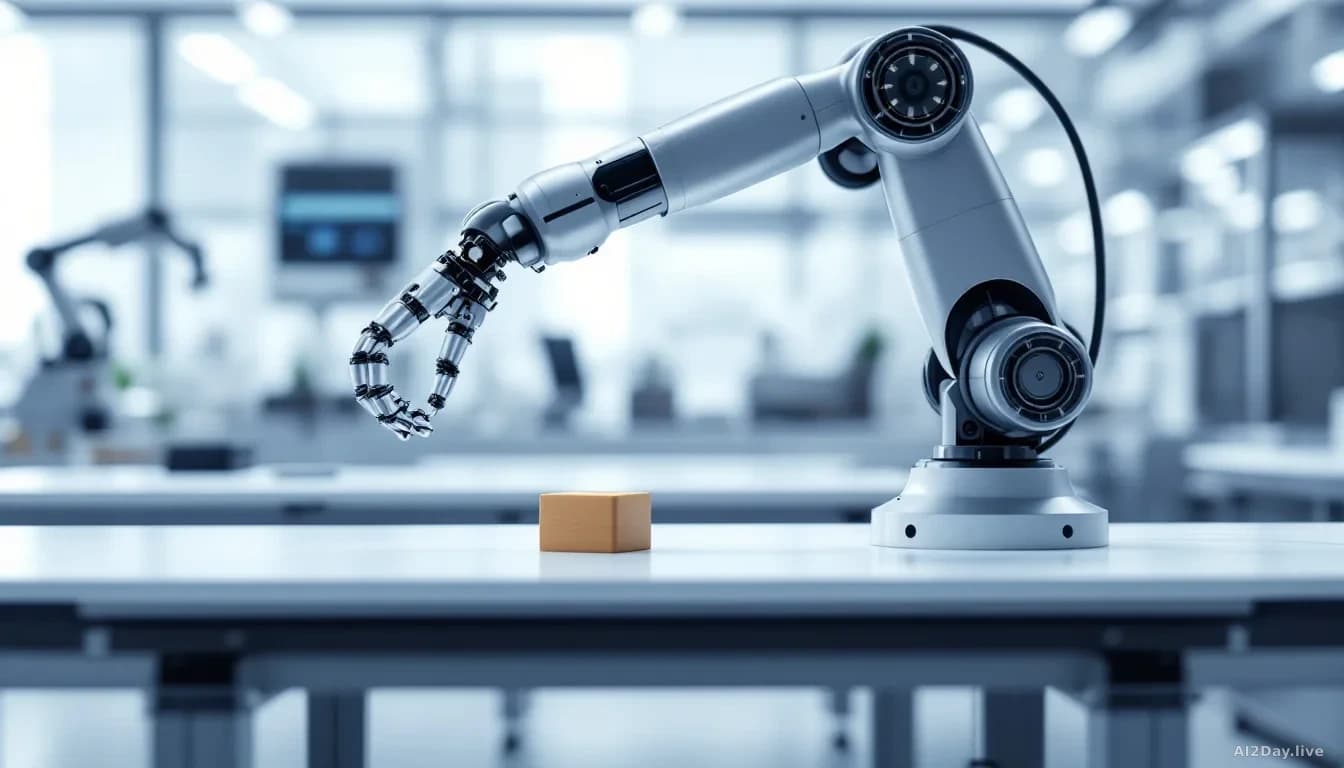
The company this week detailed how GEN-1, its foundation model (think of it as a general-purpose AI brain that controls a robot's body), now works across an unusually broad set of end effectors. An end effector is whatever sits at the tip of a robot arm: a gripper, a screwdriver, tongs or a vegetable peeler. Most robot systems are built around one fixed tool. GEN-1 is designed to handle many.
How does one AI model learn to use so many different tools?
Generalist trained GEN-1 on more than half a million hours of real robot interaction data spanning thousands of tool types. The company drew a deliberate parallel to language: just as a model trained on French and Spanish can transfer knowledge between them, a model trained on whisks and spatulas can build shared understanding of how objects behave when touched or gripped.
Each tool teaches the model something distinct. A power screwdriver spins faster than fingers can. Tongs flex and spring back. A metal scraper works against a flat surface rather than wrapping around an object. A box cutter requires steady, controlled pressure along a fixed line. Together, Generalist says, these experiences build what it calls "universal sensorimotor representations," a kind of physical common sense that transfers across tools.
The model has trained on approximately 9,000 tool variations so far, according to the company.
Can the robot really switch tools in the middle of a job?
Yes, at least in Generalist's own tests. The company demonstrated swapping a tool on the robot arm while GEN-1 was still running: the model perceived the new attachment and continued toward the same goal without reprogramming or a restart. Our 24 July 2026 story on Generalist's earlier GEN-1 announcement flagged that independent evidence on this kind of claim tends to arrive well after the demo.
This works, Generalist says, because training on mixed data forces the model to pay attention to whichever tool it currently holds, rather than assuming a fixed one.
How does Generalist know what the model still needs to learn?
The company tracks how much a new tool shifts GEN-1's internal settings, called model weights, when the model is fine-tuned (specifically trained) on that tool. A large shift signals the model found something genuinely new. A small shift means existing knowledge already covered it.
Whisks proved more disruptive than peelers. The model struggled with the thin wire geometry of a whisk, meaning its visual processing needed more training on slim, sparse objects. That finding tells Generalist exactly where to collect more data.
These are company-internal findings. As reported by The Robot Report, Generalist hasn't yet released peer-reviewed research backing these results, so independent verification is still outstanding.
What does this mean for people who use robots at work?
For now, this is research-stage technology. But the direction matters. If a single AI model can genuinely drive a variety of tools, factories and warehouses may eventually need fewer specialised robots and fewer costly reconfigurations when a task changes. The honest caveat is that every robotics company has a version of this vision right now, and the gap between polished demos and factory floors remains wide.
Generalist's stated aim: not a robot with one hand, but one intelligence paired with whatever tool the job requires.
Common questions
Is GEN-1 available to buy or use today?
Generalist hasn't announced a commercial product release. GEN-1 is currently a research model; the company is publishing capability demonstrations while expanding its training dataset.
Does this mean humanoid robot hands are becoming less important?
Not necessarily, but Generalist argues five-fingered hands should be one option among many rather than the default goal. Specialised tools often outperform human-shaped hands for specific jobs, and the company believes a capable AI model should know which to reach for.