Chinese Robotics Firm AI² Robotics Raises $735 Million at a $2.8 Billion Valuation
The Shenzhen company bets that wheeled robots, not walking ones, will win the race to put AI-driven machines on factory floors.
Key points
- AI² Robotics raised approximately $735 million in 2025, pushing its valuation past $2.8 billion USD.
- Its robot uses wheels instead of legs, making it cheaper to build and easier to deploy in regulated public spaces.
- Investors include Chinese government funds, Moutai Group, Sino Biopharmaceutical, CICC Capital, and GSR Ventures.
- The robot runs on a proprietary AI model called Alpha Brain, which handles real-time decision-making and task planning.
- AI² Robotics is targeting logistics, manufacturing, and biotech, not the household consumer market.
AI² Robotics, based in Shenzhen, has raised around $735 million from a wide group of investors, according to The Robot Report. The capital values the company at more than 50 billion RMB, roughly $2.8 billion US dollars.
The investor list spans Chinese industry broadly. Government-backed funds sit alongside pharmaceutical company Sino Biopharmaceutical, liquor brand Moutai Group, and financial firms CICC Capital and GSR Ventures. That spread signals that Beijing and the private sector both see physical AI, meaning AI that controls machines in the real world, as strategically important.
What does AlphaBot 2 actually do?
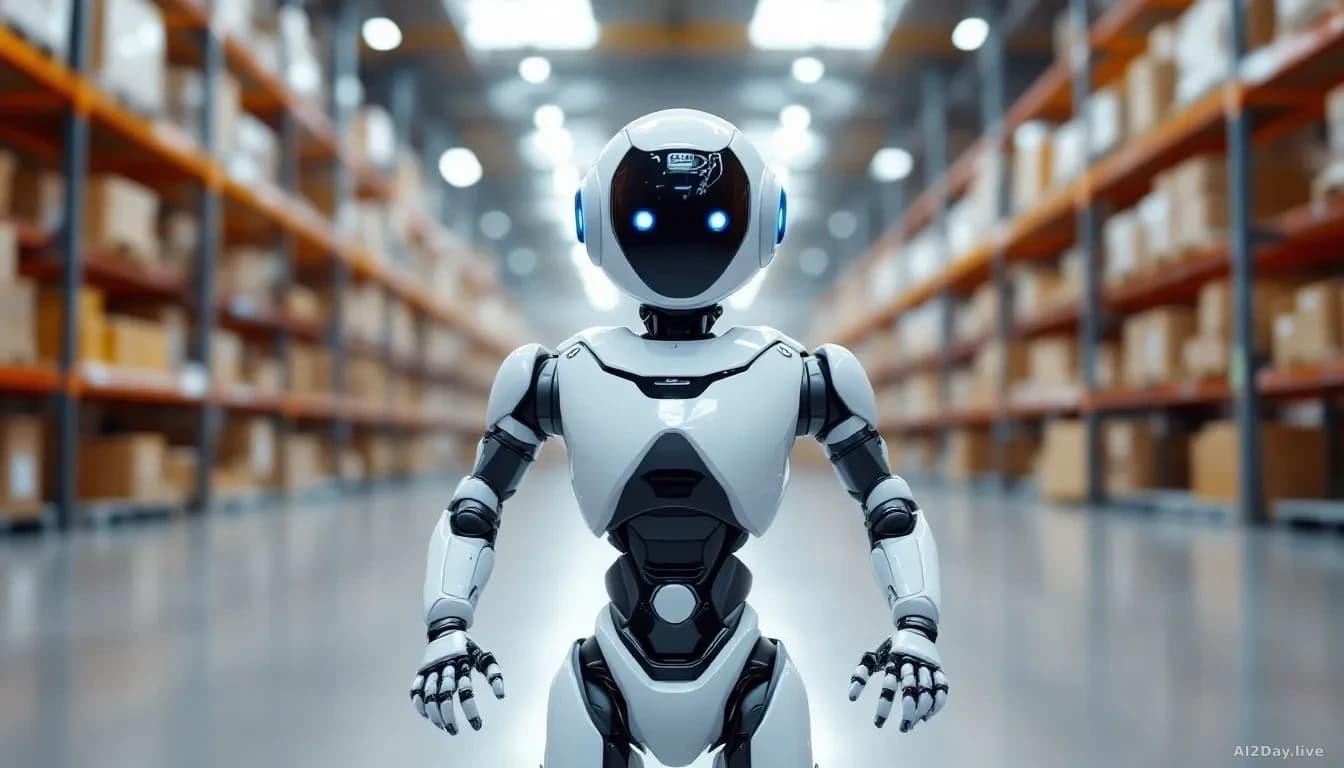
The machine looks like a humanoid from the waist up: a torso, two arms, and five-fingered hands built for delicate manipulation. Below the waist, there are no legs. It rolls on wheels.
That choice is deliberate. Walking robots capable of climbing stairs are expensive and face tighter safety regulations near people. A wheeled base is more durable and cheaper to manufacture. AlphaBot 2 carries over 34 degrees of freedom, meaning its joints move in more than 34 independent directions, giving the upper body real dexterity. A custom lifting mechanism raises and lowers the torso, so the robot can reach a high shelf or work at table height.
Will this robot actually show up in places ordinary people visit?
Sooner than most humanoid robots will. AI² Robotics is already pushing AlphaBot 2 into logistics warehouses, manufacturing lines, biotech labs, and public service settings. The company's explicit refusal to promise a household robot any time soon is a refreshingly honest position in a sector full of ambitious consumer claims. If you work in a warehouse or a large retail chain, this machine is worth paying attention to now, not in five years.
Running it all is Alpha Brain, a vision-language-action model (software that reads the environment through cameras, understands what it sees, and plans multi-step tasks without a human directing every move).
Should you worry about the competition?
This funding round arrives as money floods the broader humanoid robotics market. Rival firms including Agility, Apptronik, and Neura have recently raised capital, and Bear Robotics acquired Kinisi Robotics. The race to place useful robots in real workplaces is accelerating. We've been tracking this shift in our manufacturing automation coverage since July, including how synthetic training environments are already shaping the robots heading to factory floors.
The real test for AI² Robotics isn't the fundraise. It's whether AlphaBot 2 can hold up across thousands of shifts in a real logistics centre without the kind of costly maintenance that makes early-generation robots a liability rather than an asset.



