A fire at a $3.2 billion AI data centre left firefighters going in blind
When a blaze broke out at a partly-built New York data centre, the local fire crew found no alarms, no sprinklers, three dead hydrants, and safety documents that had apparently burned along with everything else.
Key points
- A fire broke out in early June 2025 at the Lake Mariner data centre in Somerset, New York, a facility with a construction budget of $3.2 billion.
- Barker Fire Department chief Steve Matisz said his crew entered the building "kind of blind" because the chemical safety sheets they are legally entitled to review had reportedly burned in the blaze.
- Firefighters found no working fire alarm, no suppression system, and three non-functional hydrants at the site.
- TeraWulf, UK-based AI firm Fluidstack, Google, and AI lab Anthropic all hold financial stakes in the facility.
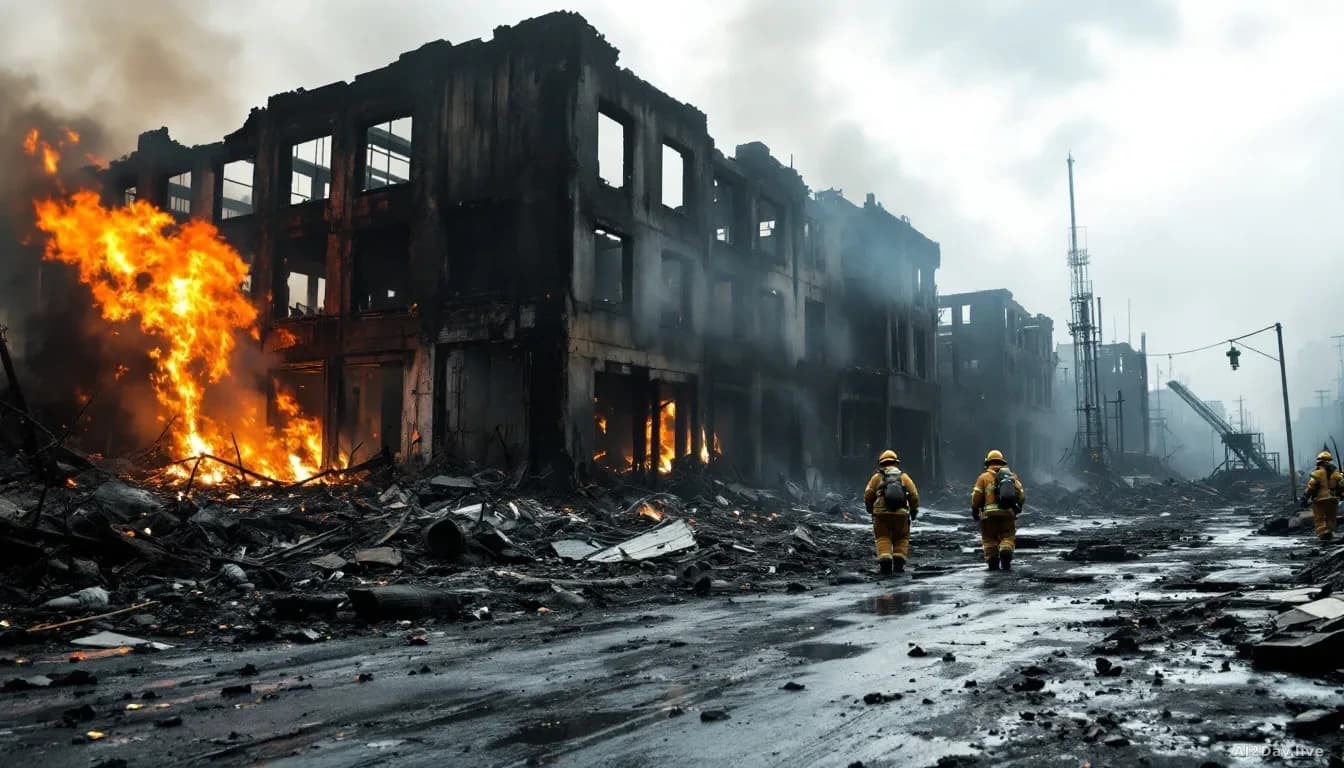
Fire crews arrived at a partly-built data centre, a large warehouse-style facility housing the computers that power AI services, in early June and discovered almost none of the safety infrastructure they expected. No working alarm. The sprinkler system was absent. Three hydrants sat dead. And, in a detail that left the local fire chief visibly unsettled, the paperwork describing the chemicals inside had reportedly gone up in the same fire the crews had come to fight.
"It's been a difficult situation," said Steve Matisz, chief of the Barker Fire Department. His team faced heavy black smoke from substances they could not identify. The law requires sites like this to keep chemical safety data sheets on hand precisely so first responders know what they are dealing with. Matisz said he was not sure what to make of the claim that those very documents had burned.
The site is a former coal mine on the shore of Lake Ontario. It is one of the largest AI data centre projects under construction in New York state. Our 2 September report on communities pushing back against AI data centres found that local opposition often centres on energy and land use; the Somerset fire adds a third concern that residents near these facilities rarely see discussed: what happens when something physically goes wrong.
Who actually owns and runs this place?
Four separate companies share pieces of the project, and the structure is unusually tangled. TeraWulf owns and operates the data centre on land it leases from a separate company owned by TeraWulf's own chief executive. Fluidstack, a UK-based AI computing firm, will manage day-to-day operations. Google holds warrants giving it a potential 14 percent equity stake and has agreed to guarantee Fluidstack's lease payments. Anthropic, the AI lab behind the Claude family of chatbots, is among the companies whose computing demand the facility was built to meet.
First reported by Ars Technica, that web of financial interests makes accountability genuinely murky: when something goes wrong at a site this complex, the company whose name appears on the front gate may not be the one best placed to answer for it.
What does this mean for ordinary people?
For residents near Somerset, the fire is the immediate concern. Data centres increasingly sit in smaller communities, drawn by cheap land and power, but local fire departments are rarely equipped or briefed to handle the chemicals and electrical loads involved. The Barker Fire Department's experience illustrates that gap directly.
For anyone who uses AI tools, this is a reminder of the physical infrastructure those services depend on. A disruption at a facility like Lake Mariner can slow or interrupt computing for the companies that rely on it.
The incident also points to a regulatory blind spot. Construction-phase safety rules do not always match the complexity of what is being built, and the companies best placed to inform first responders are not always the ones whose names appear on the front gate.
Common questions
Why would safety documents burn in a fire?
Most jurisdictions require hazardous-material data sheets to be stored on site and accessible to emergency crews. If paper copies are kept inside the building that catches fire, they can be destroyed before responders reach them. Digital or off-site backup copies would survive, but there is no universal requirement to keep them that way.
Does Google or Anthropic operate the building?
No. Google holds a future equity option and guarantees lease payments; Anthropic is a customer whose computing demand the centre serves. Neither company manages the physical site. Day-to-day operations are handled by Fluidstack, under an agreement with site owner TeraWulf.