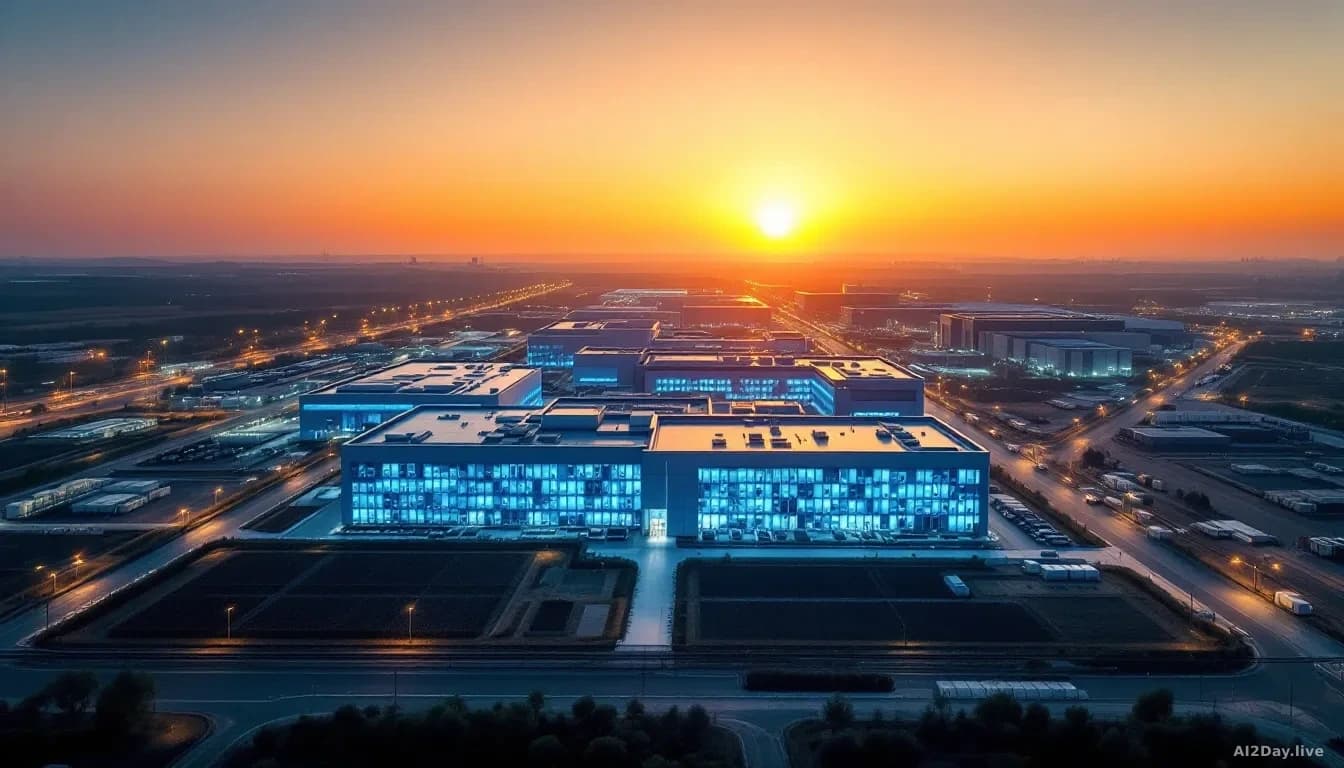
A $500 Billion AI Datacenter Is Being Built in Rural Ohio. Not Everyone Is Happy About It.
OpenAI, Nvidia and Japanese investors are pouring half a trillion dollars into what could be the world's largest AI computing facility, tucked into the Appalachian foothills near Piketon, Ohio. The jobs sound good. The questions about land, water and power are harder.

Key points
- OpenAI, Nvidia and Japanese investors plan to spend $500 billion on an AI datacenter complex near Piketon, Ohio.
- The facility is designed to deliver 8 gigawatts of computing capacity, a scale rarely attempted anywhere on Earth.
- US Energy Secretary Chris Wright and Commerce Secretary Howard Lutnick attended a ceremony at the site last March.
- Local supporters say the project will create thousands of jobs in a region that has long struggled economically.
- Environmental groups have raised concerns about energy consumption, water use and impact on local ecosystems.
Deep in the Appalachian foothills of southern Ohio, down a winding road flanked by forest, something enormous is being built. OpenAI, the company behind ChatGPT, is joining Nvidia, the chip-maker whose processors power most modern AI systems, and a group of Japanese investors to construct what is being described as one of the largest AI datacenters on the planet. The price tag is $500 billion. The site is Piketon, a small community in Pike County that has spent decades looking for an economic lifeline.
We've covered this project's financing in depth: our 19 August story reported that Nvidia is guaranteeing power and land costs at the site, and our 17 August report found the chipmaker extended up to $105 billion in credit to help get it built.
What exactly is being built?
The project aims to deliver 8 gigawatts of AI computing capacity. That's not electricity for homes; it's power for the specialised chips that train and run AI systems at a scale that requires its own supply chain.
Last March, Energy Secretary Chris Wright and Commerce Secretary Howard Lutnick travelled to Piketon for a ceremonial start to construction, joined by Japanese dignitaries. The mood was enthusiastic.
Who benefits, and who is worried?
For Piketon and Pike County, the promise is straightforward: thousands of jobs in a part of Ohio where well-paid work has been scarce for a generation. That promise carries real weight in a region that once relied on the Portsmouth Gaseous Diffusion Plant, a Cold War-era uranium enrichment facility that closed and left behind job losses and a long environmental cleanup.
Environmental groups aren't celebrating. Their concerns, first reported by The Guardian, centre on what a facility this size will demand from the surrounding area: energy consumption, water used to cool the servers, and the broader impact on local ecosystems. The specific objections are still emerging as construction advances.
What does this mean for ordinary people in the region?
If the jobs materialise at the scale promised, Piketon could see a genuine economic shift. Datacenter campuses typically bring construction work first, then permanent roles in operations and security.
The catch is that large infrastructure projects frequently promise more jobs than they deliver, and the gap between a ceremonial start and full employment can stretch years. Residents are right to welcome the possibility while watching the specifics closely. For those living near the site, the practical questions are about water and power: who monitors what an 8-gigawatt facility consumes around the clock, and what happens when something goes wrong.
What I'd tell a colleague: the financing here is real and unusually committed, but the job numbers are still projections and the environmental review is nowhere near finished. Watch the water permits.
Common questions
Why does an AI datacenter need so much power?
AI systems, especially the large models behind tools like ChatGPT, require thousands of specialised chips running continuously. Those chips generate enormous heat and need constant electricity, making large datacenters among the most energy-intensive structures humans currently build.
Is $500 billion actually being spent all at once?
No. Large infrastructure investments like this are staged over many years, with funding released in phases as construction milestones are met. The headline figure represents a long-term commitment, not a single payment.