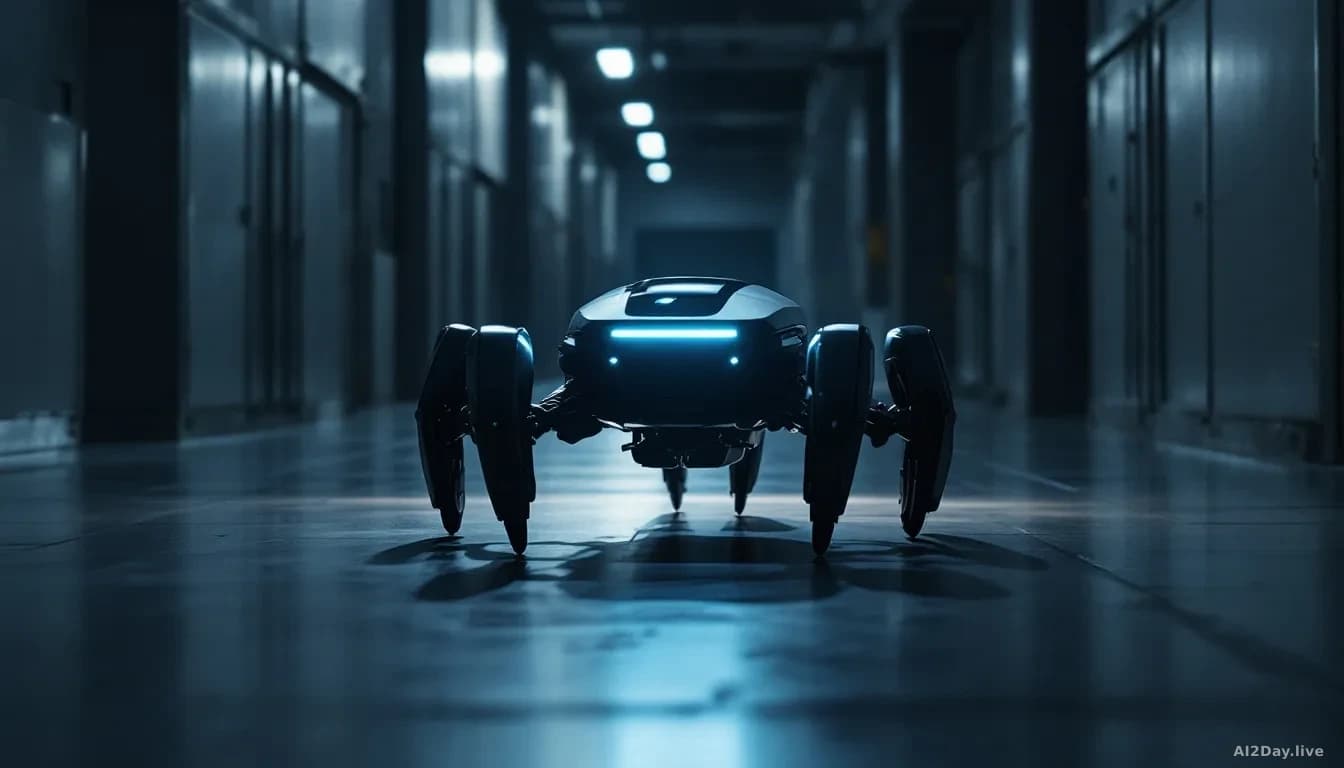
NSF Commits $90 Million to Three New Research Centers, One Built Around Robots That Learn From People
The National Science Foundation is funding a new centre at the University of Texas at Austin where scientists will teach robots to adapt to the humans they work alongside.

Key points
- The U.S. National Science Foundation announced $90 million in funding spread across three new Science and Technology Centers.
- Each centre receives $6 million per year for five years, with a chance to compete for five more years of support after that.
- One centre, led by the University of Texas at Austin, will study how robots can safely learn from and adjust to individual people.
- The other two centres focus on turbulence physics (Michigan State University) and genome engineering (Northwestern University).
- The NSF's Science and Technology Center programme has run since 1987 and has seeded dozens of start-up companies and new research fields.
The National Science Foundation, the main federal agency that funds basic scientific research in the United States, said it will put $90 million into three newly created Science and Technology Centers over the next five years: $6 million a year per centre. After the first five years, each can apply for a second five-year term.
First reported by The Robot Report, the announcement covers a wide spread of fields: robots that work beside people, the physics of turbulent fluid flow, and tools for rewriting genetic code.
What is the robot centre actually trying to do?
Based at the University of Texas at Austin, the Centre for Human and Robot Co-Adaptation wants robots to stop being one-size-fits-all. Right now, most service robots, the kind designed to help in homes or hospitals, follow fixed programmes. They can't easily adjust if a person moves differently or works in an unpredictable space.
Researchers will combine robotics, artificial intelligence (the branch of computer science that lets machines learn from data and make decisions), and the study of human behaviour. The goal is to give robots what the researchers call embodied intelligence: the ability to watch a person, understand what that person prefers, and then change their own movements and responses to suit that individual.
For a nurse whose ward is always rearranging itself, or an older adult who needs a helper robot to keep pace with a changing routine, that adaptability matters far more than raw speed or strength. Our 17 August story on Moxi 2.0, the hospital robot that learns on the job shows how much demand already exists for exactly this kind of in-context learning.
What are the other two centres?
Neither of the remaining centres focuses on AI or robotics directly. Michigan State University will lead TEMPEST, the Centre for Explorations in Multi-Physics and Engineering of Scientific Turbulence, studying how fluids behave chaotically in engineering systems. Northwestern University will lead GENIE, the Centre for Genome Intelligence Engineering, working on tools that can read and edit genetic information with greater precision.
| Centre | Lead university | Focus area |
|---|---|---|
| Human and Robot Co-Adaptation | University of Texas at Austin | Human-robot learning and adaptability |
| TEMPEST | Michigan State University | Turbulence physics and engineering |
| GENIE | Northwestern University | Genome engineering |
All three sit inside a programme the NSF has run since 1987. Over nearly four decades, it has helped create new scientific fields and spin out numerous start-up companies.
What does this mean for ordinary people?
Directly, very little changes today. These are research investments, not products shipping to shelves. The Austin centre's work points toward a future where a hospital robot adjusts its pace to match an elderly patient, or a home assistant learns that one person likes reminders spoken aloud while another prefers a quiet screen alert. That kind of personalised, safe robotic help is what this funding is designed to move closer to reality. The harder barrier may be voice: as we reported on 15 August, poor hearing and clumsy speech interaction remain a stubborn bottleneck even when the underlying movement is excellent.
Common questions
Will any of this research become a product I can buy?
Not soon. The centres are doing foundational research, meaning they're building the scientific base that companies can later use. Products built on this kind of work typically take a decade or more to reach consumers.
Does this funding affect AI tools I use now, like chatbots?
No. The centres focus on physical robots and scientific research, not the large language models (the technology behind chatbots like ChatGPT and Claude) that most people encounter day to day.