XTEND wins US patent for drones that find their own way to a target
The defence robotics firm secured US Patent No. 12,222,735 for navigation software that lets unmanned aircraft head toward a goal without a pilot steering every move.
Key points
- XTEND Reality Inc. Received US Patent No. 12,222,735, covering autonomous drone navigation technology, in 2025.
- The patent carries corresponding protection in Israel.
- XTEND reports more than 10,000 systems deployed across more than 30 countries.
- The company is merging with JFB Construction Holdings and plans to trade on Nasdaq under the ticker "XTND".
- XTEND is one of 19 companies that qualified for Gauntlet II, a phase of the US Department of Defense's $1 billion Drone Dominance Program.
A Florida defence company has patented software that lets a drone fly itself toward a target when the path ahead can't be mapped in advance. XTEND Reality Inc., based in Tampa, received US Patent No. 12,222,735 last week. Israel granted matching protection at the same time.
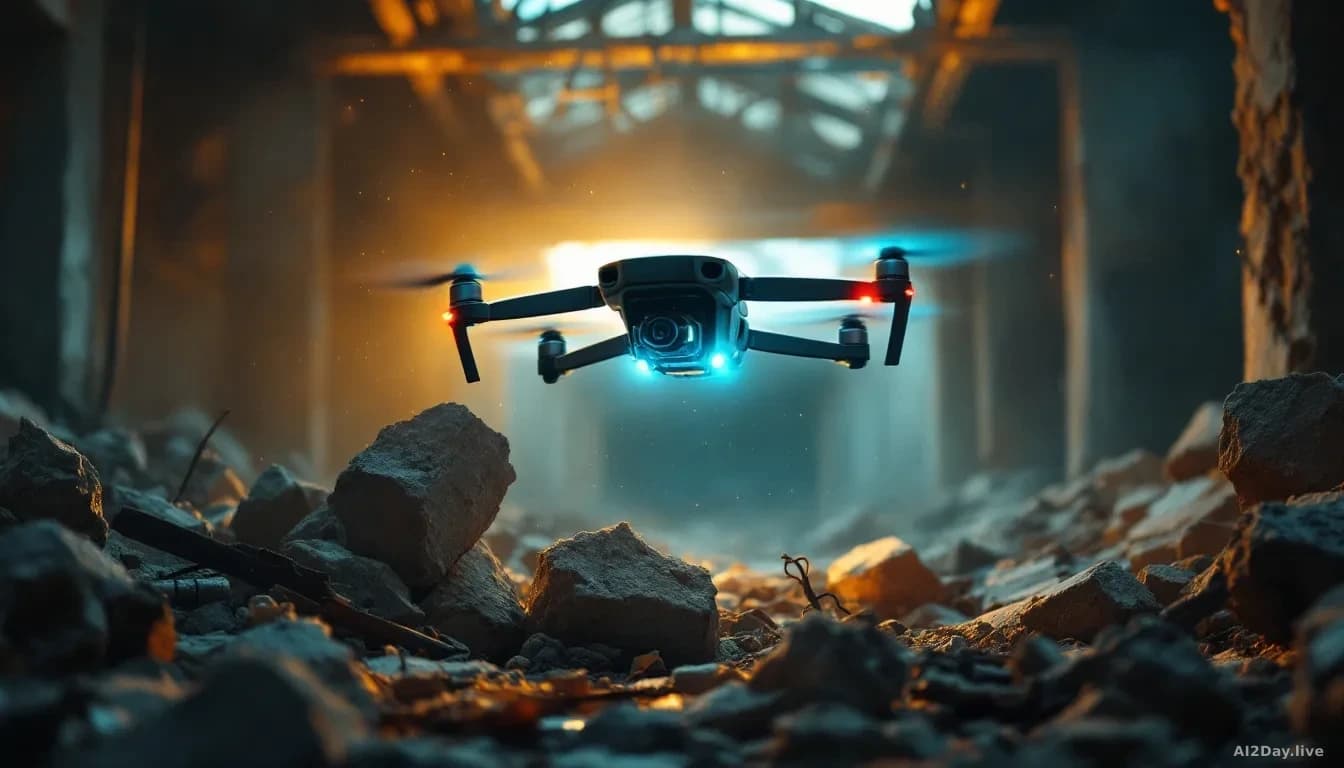
Today, many drones still need a pilot to guide every turn. XTEND's patented approach gives the aircraft a destination and lets it work out the route independently, adjusting as it encounters walls or rubble. The operator sets the mission goal; what the aircraft does next is the software's problem.
That matters in places where a human operator can't see what's ahead or react quickly enough. XTEND says the technology reduces the mental load a single operator carries during a complex mission.
The navigation system lives inside XTEND's proprietary XOS, short for XTEND Operating System. Think of XOS as the Android or iOS of defence robots: one operating layer that controls drones, ground vehicles, and water-based systems simultaneously. A single operator can supervise several of these robots at once.
XTEND co-founder and CEO Aviv Shapira described the goal plainly: "Autonomy is not simply about moving a robot from Point A to Point B. It is about translating human intent into reliable mission execution, even in unfamiliar, dynamic environments."
Founded in 2018, the company reports over 10,000 systems deployed across more than 30 countries, validated in five combat zones, and more than $12 million in cumulative defence orders, including $3 million in recent follow-on contracts.
On the competitive front, XTEND was among 19 companies selected to advance in the Gauntlet II phase of the US Department of Defense's $1 billion Drone Dominance Program. That test, focused on autonomous one-way attack drones, is scheduled for August at Fort Carson in Colorado.
What does the planned stock-market merger mean for the company?
XTEND isn't yet publicly traded, but that's set to change. In February, XTEND agreed to an all-stock merger with JFB Construction Holdings, a general contracting firm active in 36 US states. Existing XTEND shareholders will hold roughly 70 percent of the combined company, with JFB shareholders taking the remaining 30 percent. The combined business, to be called XTEND AI Robotics, plans to list on Nasdaq under the ticker "XTND" midyear, pending regulatory sign-off. Shapira will lead it.
For ordinary observers, the merger is mainly a story about a defence technology firm gaining the public-market access it needs to scale. Production facilities already run in the US, the UK, Singapore and Latvia, plus Israel, as first reported by The Robot Report. The public listing is what makes the next phase of that expansion possible to fund.



