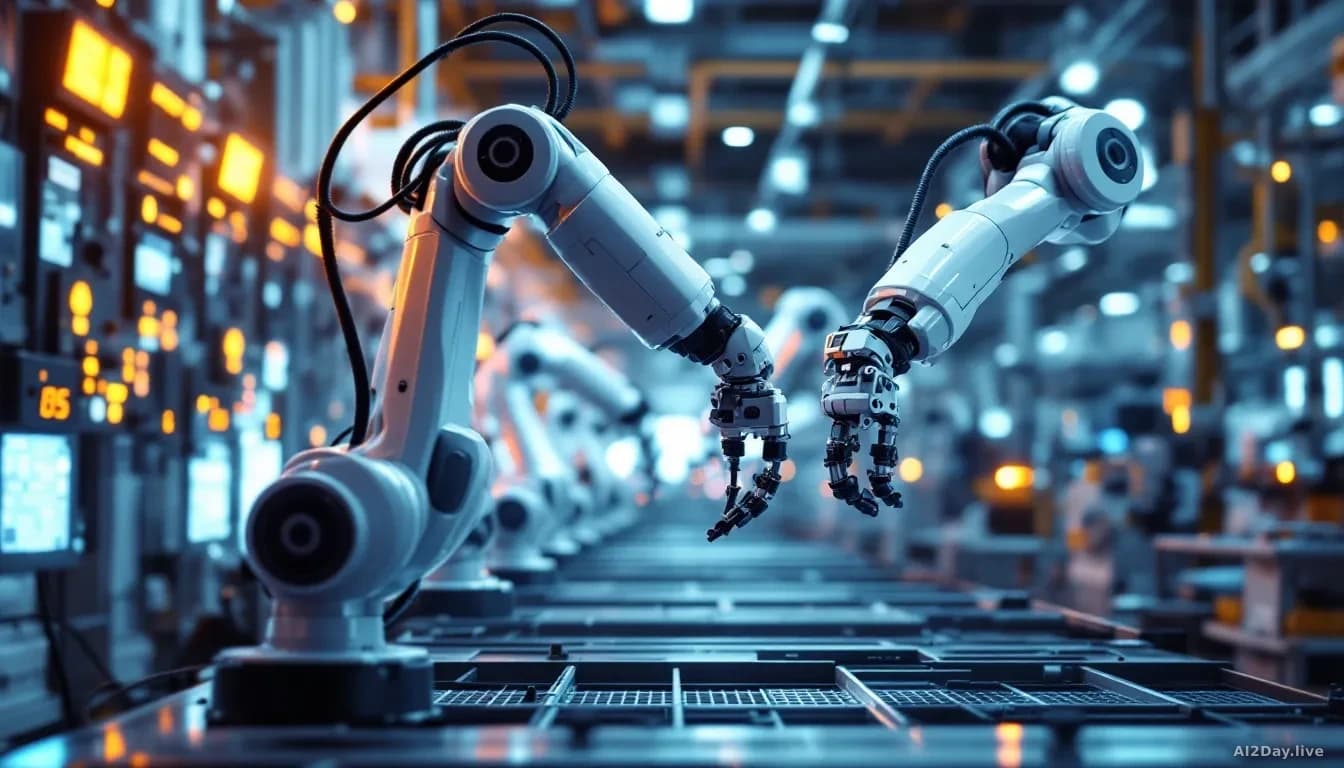
This London startup wants factory workers to train robots the same way they would train a new hire
Reimagine Robotics says its system cuts the time to teach a robot a new task from a full day down to ten minutes, and it needs no specialist programmers to do it.
Key points
- Reimagine Robotics, a London and Sydney startup, came out of stealth in 2025 after roughly a year of quiet development and customer testing.
- The company's technology lets ordinary workers teach robots new tasks by demonstrating them directly, then correcting mistakes on the spot, with no coding required.
- In a hard-drive disassembly project, Reimagine cut the time to prototype a new robot behaviour from about one day to roughly ten minutes.
- The startup's founding team includes CEO Jonathan Scholz, who founded Google DeepMind's Applied Robotics team in London and ran it for seven years.
- Reimagine has already deployed robots in a 3D-printing plastics business and an electronics recycling facility, with more deployments and a new funding round planned.
Teaching a robot used to mean hiring a specialist programmer and waiting days. Reimagine Robotics, a startup that emerged from stealth this week, says it's got a different answer: let the person who actually does the job do the teaching.
The system works on a show-and-correct principle. A worker demonstrates a task, the robot tries to copy it, and the worker fixes any mistakes. No code required, no robotics background needed.
"A useful robot should be able to learn from the person doing the work," said co-founder and CEO Jonathan Scholz, who built Google DeepMind's Applied Robotics team in London, led it for seven years, then co-founded Reimagine in April 2025 with Oleg Sushkov, Akhil Raju and Misha Denil.
What does it actually do in practice?
The company has already put robots to work in two real facilities. At a made-to-order plastics company, Reimagine's robots learned to tend 3D printers overnight, removing finished print beds, operating latches and pressing controls. The customer's own staff then used the platform to add extra stages: washing parts, curing them and drying.
A second project involved recovering valuable materials from used hard drives. Reimagine worked with process engineers to build a three-robot disassembly cell where machines and people worked side by side. During that project, prototyping a brand-new robot behaviour dropped from roughly a full day to about ten minutes, according to the company, so engineers could propose an idea in the morning and watch it run before lunch.
| Deployment | Task taught | Key result |
|---|---|---|
| Plastics manufacturer | 3D-printer tending, washing, curing, drying | Workers extended automation themselves, no programmer needed |
| Electronics recycler | Hard-drive disassembly, three-robot cell | Behaviour prototyping time: ~1 day to ~10 minutes |
Scholz frames the technology as a tool that sits alongside people. "Instead of someone having to repeat a tedious physical task thousands of times, they can teach the robot, and apply that ability wherever it is needed," he said.
Our 30 July story on Google DeepMind's Gemini Robotics 2 covered a parallel push toward robots that follow natural instruction rather than hard-coded commands, which puts Reimagine's worker-led model in good company.
What happens next?
A new funding round is the immediate priority. The startup's first phase was backed by pre-seed money from Fly Ventures, firstminute capital and angel investors. Scholz says the next stage will focus on hiring more deployment staff, expanding into additional factories, and proving that each new installation gets faster than the last.
As first reported by The Robot Report, Reimagine joins a crowded field trying to make robots easier to train, including 1X Technologies, Apptronik and Sanctuary AI. The differentiator it's betting on is speed: the faster a factory worker can teach a robot something new, the more useful it becomes as products change.
If this delivers, training a robot may look less like writing software and more like onboarding a new colleague. That's the promise. Watch whether the funding round closes at a scale that can support the multi-factory rollout Scholz describes.