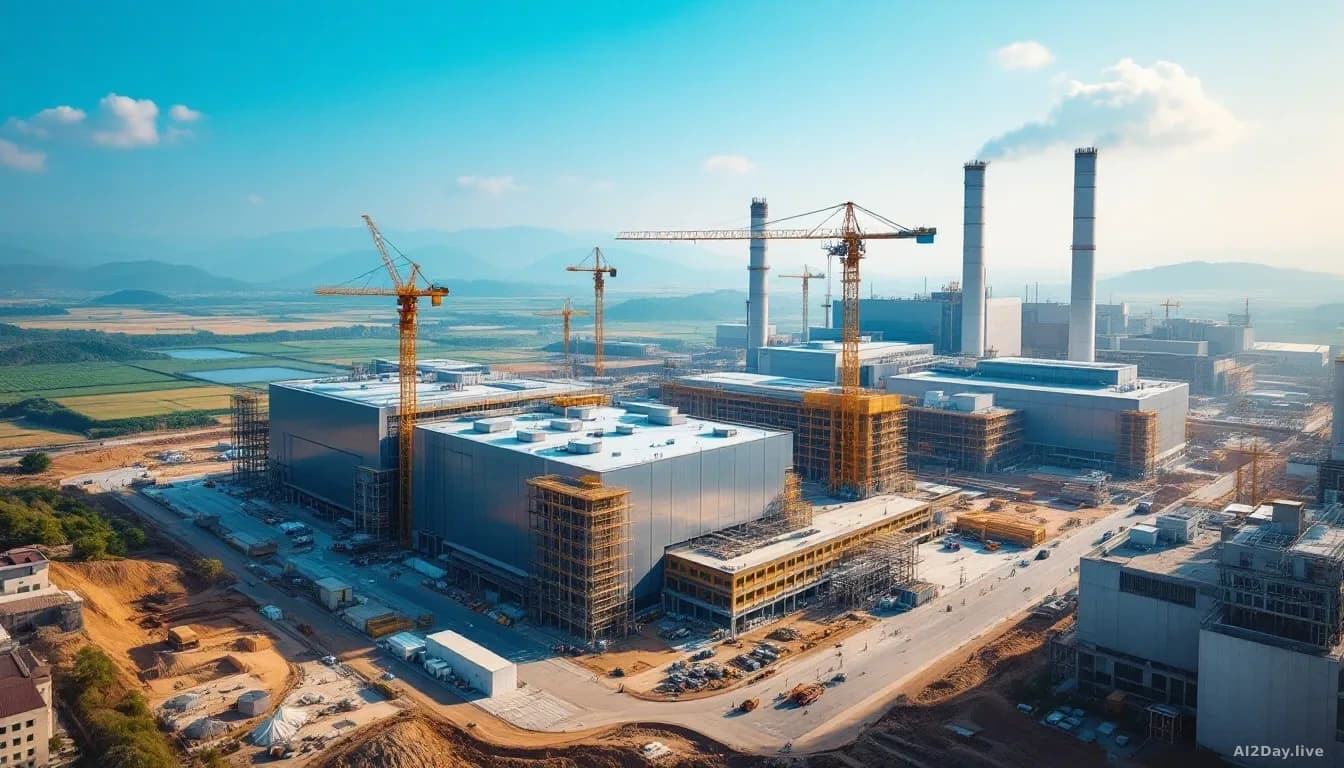
The only company that makes AI's most important machine just raised its sales forecast again
ASML, the Dutch firm that builds the chip-printing machines the entire AI industry depends on, now expects up to 45 billion euros in sales this year, a forecast it has already lifted twice.
Key points
- ASML raised its full-year 2025 revenue forecast to between 43 billion euros and 45 billion euros, up from a previous range of 36 billion to 40 billion euros.
- Q2 net sales hit 9.3 billion euros, beating analyst expectations of 8.8 billion euros.
- Shares have surged 115% this year, settling around 4.4% higher after an early 7% jump on Wednesday.
- ASML is the only company on Earth that makes EUV lithography machines, the specialist equipment used to print the world's most advanced chips.
- A Morningstar analyst says the stock looks "slightly overvalued" at roughly 50 times forward earnings.
ASML, based in Veldhoven in the Netherlands, makes machines that are unlike anything else on the planet. Its extreme ultraviolet (EUV) lithography machines, enormous precision instruments that use bursts of ultraviolet light to print microscopic circuit patterns onto silicon, are the only way to produce the most advanced chips available today. No AI chip gets made without one.
On Wednesday the company announced a second forecast upgrade in 2025. Revenue guidance now stands at 43 billion to 45 billion euros (roughly 49 billion to 51 billion US dollars), up from the earlier 36 billion to 40 billion euro range. CEO Christophe Fouquet said order intake had been "extremely strong" in the first half of the year, with customers accelerating capacity expansion plans across ASML's product range.
That is a big shift, and the reason is straightforward: chipmakers are spending hard to keep up with demand for AI hardware.
What does this mean for ordinary people?
It means the AI buildout is still accelerating, and the companies supplying the picks and shovels are doing very well. Taiwan Semiconductor Manufacturing Co (TSMC), the world's largest contract chip manufacturer and one of ASML's biggest customers, reported a 68% jump in June sales and is adding two advanced chip packaging plants in southern Taiwan. Those plants need ASML machines.
For anyone who banks or uses a phone, faster chip production generally means better and cheaper AI features over time. The bottleneck right now is supply, not ideas.
ASML's second-quarter net profit came in at 2.9 billion euros, beating analyst expectations of 2.6 billion euros, as first reported by CNBC Tech. AI2Day has covered ASML's position in the chip supply chain since 18 July 2026; the China dimension of that story connects directly to our earlier piece on Nvidia H200 exports.
Not everyone's relaxed. The stock trades at roughly 50 times expected forward earnings, a level Morningstar's Javier Correonero compared to the frothy valuations seen during the Covid boom. He called the shares "slightly overvalued" and said a fairer multiple would be 35 to 40 times earnings.
Should you worry about China?
There's a geopolitical wrinkle worth watching. A bipartisan group of US lawmakers proposed a bill in April that would ban ASML from selling its older deep ultraviolet (DUV) machines, a lower-specification but still widely used type, to Chinese chip companies. ASML's stock fell 6% that month. The bill hasn't passed yet.
ASML said Wednesday it still expects China to account for around 20% of annual net sales. Correonero noted that past export restrictions have sometimes pushed Chinese buyers to order more machines faster, fearing tighter rules ahead.
Honest read on this one: if you hold broad index funds, you've already got some exposure here. ASML's continued strength confirms that big AI spending is real. But a stock up 115% in a year, trading at Covid-era valuations, deserves caution alongside the excitement.