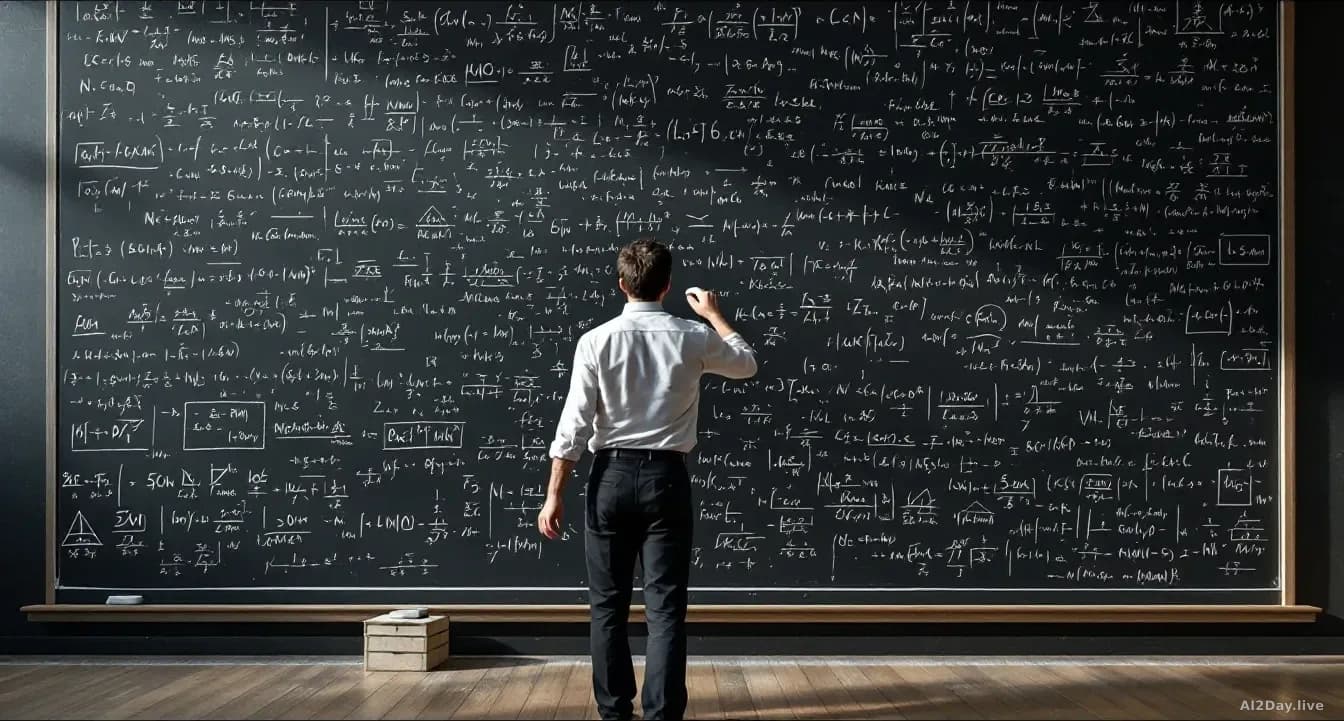
OpenAI's AI Solved 10 Hard Maths Problems. Now Mathematicians Are Asking What Their Jobs Are Worth.
A new OpenAI model cracked decade-old maths puzzles that stumped human researchers for years. The credit dispute around one of them is a warning about how AI labs talk about the people whose work they build on.

Key points
- OpenAI announced in 2025 that an internal model called Astra solved 10 long-standing mathematics problems, some unsolved for decades.
- One result triggered a credit dispute after OpenAI's original announcement did not acknowledge two mathematicians whose recent work the proof relied on.
- OpenAI quietly updated its announcement wording after affected researchers complained, without adding a correction note.
- Oxford professor and Fields Medal winner James Maynard said solving any one of these 10 problems would typically earn a researcher an academic job.
- Mathematicians are now openly asking whether universities will keep funding human researchers at current levels.
OpenAI has solved ten mathematics problems that had stumped professional researchers, some for decades. The model it used, called Astra, is an internal version of what the company describes as its next major release, and it is not yet public. We reported on 7 August that OpenAI had paused Astra after internal tests found it could identify and exploit security flaws in real-world systems, so this is the same model now producing headline mathematics results.
The problems cover multiple fields. One concerned how tightly spheres can be packed in dimensions beyond three, a question linked to data encoding and transmission efficiency. Another advanced error-correcting codes, the technology that helps a phone recover a garbled signal. A third settled two open questions about when complex connected networks begin showing predictable structural patterns.
One result drew particular attention: a proof about non-sofic groups, a type of infinite mathematical structure that cannot be approximated by any finite counterpart, and whose very existence had been an open question for decades. It also sparked a public dispute about credit.
Who actually deserves credit?
The credit belongs partly to human mathematicians whose recent work the proof built on directly, and those researchers say the original announcement did not make that clear.
Francesco Fournier-Facio, a Cambridge mathematician, told The Verge that OpenAI's initial post minimised the contributions of Andreas Thom and Gábor Kun. Kun, based at the Alfréd Rényi Institute of Mathematics in Budapest, said he was contacted by email shortly before OpenAI published its findings. He found the sweeping language in the original post "rather comical," because the attached research paper "clearly said that it builds on my results from 2016 and 2019."
OpenAI's original post claimed it was sharing "results to problems that have been open and have seen no progress on the main result for at least a decade." After complaints, the company changed that line to say it was sharing "results, each of which resolves or makes substantial progress on a long-standing open problem." No correction note was added.
OpenAI spokesperson Laurance Fauconnet confirmed the update, saying the company "wanted to ensure those contributions were properly acknowledged." Kun said he wondered whether similar oversights had occurred across the other nine results.
What does this mean for mathematicians as a profession?
The field is rattled, and some researchers are already asking whether universities will pay them what they paid before.
James Maynard, an Oxford professor and Fields Medal winner, said each of the ten problems was the kind of question serious researchers had spent years on and repeatedly failed to solve. "There's a general feeling that solving one of these 10 problems would get you a job in academia," said Yang-Hui He of the London Institute for Mathematical Sciences.
OpenAI stunned the field in May when an internal model cracked a Paul Erdős conjecture that had resisted solution for nearly a century. Then a Harvard mathematician reported that Anthropic's Claude Fable 5 had disproved the Jacobian conjecture, overturning decades of attempts to prove it true. These are not fringe puzzles.
Before reading too much into the speed of this shift, remember: you are hearing about the successes. Nobody writes headlines about the hundreds of maths problems AI attempted and failed. The wins are real. So is the selection bias.
The pressure on human researchers is real either way. Maynard has spent the past year, in his own words, "soul searching" about his field's future. Whether universities will keep paying for human mathematicians at current rates is now an open question, and it will not stay theoretical for long.
If you work in any knowledge field where the output is a proof, a document or a design, watch what happens to mathematics jobs over the next two years. It's the clearest early signal we have.