AI is designing physics experiments that scientists never thought to try
From gravitational wave detectors to quantum optics, artificial intelligence is now proposing experimental setups that outperform anything humans designed by hand. Here is what that means for science, and for patients.
Key points
- AI tools have designed gravitational wave detector layouts that outperform current next-generation human-designed versions, according to a 2025 paper in Physical Review X.
- A 2023 tool called PyTheus generated 100 distinct quantum optics experiments automatically, many involving photon arrangements researchers had not previously considered.
- An early AI experiment-design program called Melvin, built in 2016, proposed quantum light experiments that real laboratories later built and confirmed.
- AI-designed instruments now span particle physics detectors, fusion reactor coils and neutrino-detecting antennas.
- All results below are from peer-reviewed research; company press releases are not involved.
Scientists have always designed their own experiments. They read the literature, form a hypothesis, sketch an apparatus, then spend months building and testing it. That process is painstakingly human.
A growing body of peer-reviewed research suggests AI can now shoulder part of that creative work, and sometimes do it better.
What has AI actually designed?
The evidence runs wider than most people realise. Across at least half a dozen fields, AI systems have proposed experimental layouts that researchers built or verified by simulation.
In quantum optics, the study of individual particles of light and how they interact, a 2016 program called Melvin searched automatically for new experimental configurations. Several setups it proposed were later built in real laboratories and shown to work. A 2023 successor called PyTheus went further, generating 100 different quantum experiments in one automated run.
In particle physics, Bayesian optimisation, a method that builds a statistical model of which choices are likely to work and focuses its search there, improved the design of a large detector for CERN's SHiP experiment. Separate teams used evolutionary algorithms, which mimic natural selection by repeatedly mutating candidate designs, to build antennas more sensitive to ultra-high-energy neutrinos.
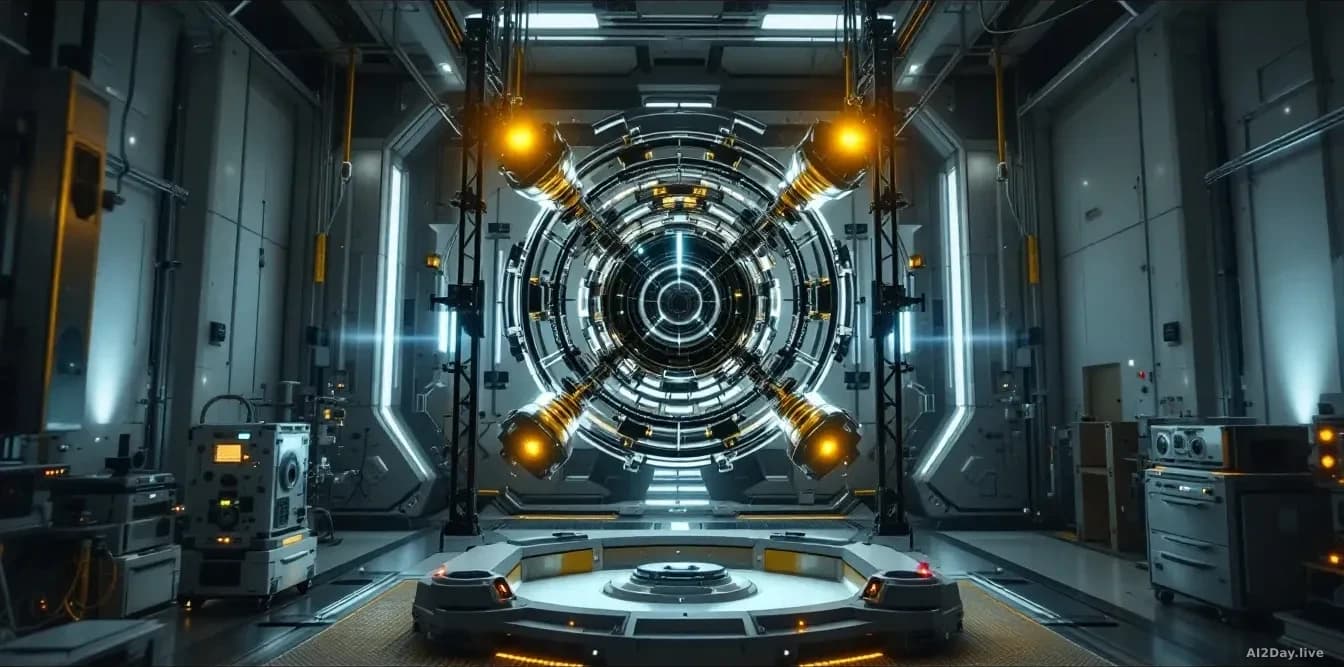
The most striking example involves gravitational wave detectors, the giant laser instruments that sense ripples in spacetime caused by colliding black holes. A 2025 study in Physical Review X showed that an AI exploring a broader-than-usual design space found interferometer layouts, meaning the geometric arrangement of laser paths, that outperformed current next-generation human designs under realistic operating conditions.
Why can AI find designs humans miss?
Human designers face a practical limit: they tend to search near what has already worked. An AI given an "overcomplete" search space, one that includes far more possible arrangements than any physicist would bother sketching, can explore distant corners without fatigue or preconception.
The PyTheus framework and the gravitational-wave study both exploited this. Letting the algorithm roam freely, rather than constraining it to known topologies, is where the genuinely surprising results appear.
What about medicine and biology?
The same logic extends beyond pure physics. A 2024 tool called XLuminA, published in Nature Communications, automatically discovered experimental designs for imaging at resolutions far finer than ordinary light microscopes allow. Related work covers AI-designed protein structures and new molecules for drug discovery.
For patients, the most direct path from this research runs through drug discovery and medical imaging. It's a connection our earlier story on AI-assisted robot labs examined from the biofoundry side: once AI can propose both the molecular candidate and the instrument to study it, the early stages of development compress. That path is still long, but it's getting shorter.
What does this not mean?
AI isn't replacing scientists. Every result listed above required human researchers to frame the problem, set the rules of the search, interpret the output, then build and test the proposed apparatus. The AI proposes; the physicist decides.
None of these systems understand physics the way a person does. They optimise within boundaries that experts define. Push those boundaries badly and the machine will propose nonsense with equal enthusiasm.
What I'd tell a colleague: the genuinely useful thing here isn't that AI is creative, it's that it's tireless. It covers search space no human team would bother mapping. The risk worth watching is that the problems being handed to AI grow easier to specify than to interpret, and the hard scientific judgment gets quietly outsourced along with the tedious part.
Common questions
Does this affect medical research directly?
Yes, indirectly. AI-designed microscopes and molecular structures feed into the early stages of drug and diagnostic development, though any resulting treatment would still need years of clinical trials before reaching patients.
Are these AI systems available to ordinary researchers?
Some are open-source. PyTheus is publicly available, and XLuminA was released alongside its Nature Communications paper. Most require significant computing resources and physics expertise to use meaningfully.