A Tiny AI Model Just Got a Big Boost With 100 Training Steps and a Free GPU
A new public guide shows how to make a small language model noticeably better at following output instructions, using only free computing tools and about 500 training examples.
Key points
- A fine-tuned version of LFM2.5-350M, a small language model with 350 million parameters, improved its structured-output score from 22.6% to 29.7% on the IFStruct benchmark.
- The training run uses roughly 500 examples and 100 steps, small enough to fit on a free GPU from Google Colab or Kaggle.
- GRPO (Group Relative Policy Optimisation) is the training method: a reinforcement-learning technique that scores each AI response and nudges the model toward better answers.
- The full code is publicly available on GitHub, so anyone can repeat or adapt the experiment.
- IFStruct is an open benchmark that tests whether a model reliably returns output in the exact format a developer requested.
If you've ever asked an AI tool to return a neat structured answer and got a jumbled mess, this story is about fixing that problem cheaply.
Researchers published a practical guide, highlighted by Hugging Face, showing how to take a small language model and make it considerably better at following precise formatting instructions. It costs almost nothing to do.
What problem does this actually solve?
When developers build apps on top of AI, they usually need the model to return data in a specific shape. A tidy block of JSON, a standard data format that software can read directly, is the common example. If the model goes off-script and adds extra fields or drops required ones, the whole app can break.
That property, returning output that matches the requested structure every time, is called schema compliance. Most AI benchmarks lump it in with other skills and never measure it alone. IFStruct does measure it on its own, across 2,000 tests, which is why it's the yardstick here.
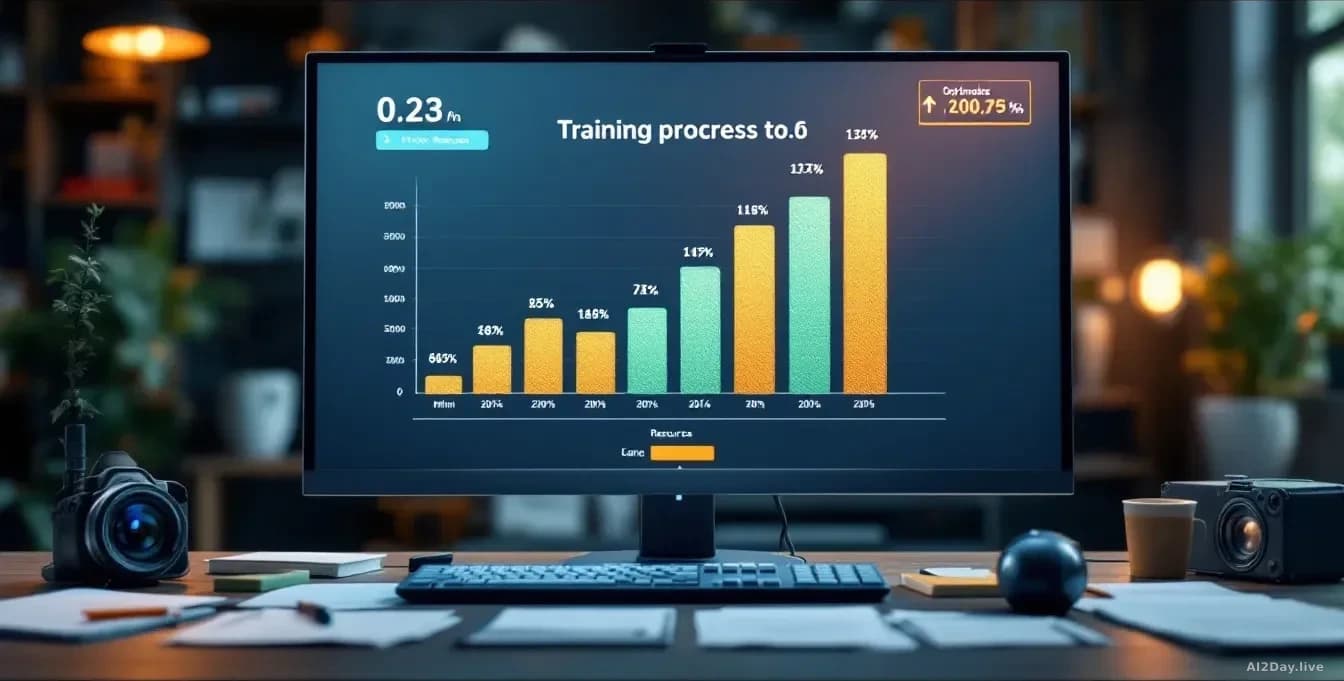
The base model passed 22.6% of those tests before any extra training. After the fine-tuning described in this guide, it passed 29.7%. That's a meaningful jump for a model this size, achieved without expensive hardware.
How does the training work?
The technique is GRPO, Group Relative Policy Optimisation, a form of reinforcement learning where the model tries several answers to each question and gets a score for each one. Better answers earn higher scores, and the model gradually learns what better looks like.
Three scoring rules judge each answer. First: is the output readable by software, and does it match the format the prompt requested? Second: does the response contain the right number of fields? Third: does it fully satisfy the data rules, the schema, the developer specified? Schema compliance is weighted most heavily, because that's usually the deal-breaker in real apps.
The researchers augmented the training prompts to cover two gaps between the training data and the benchmark. Forty percent were rewritten to demand output inside a formatted code block. A separate twenty percent were converted into list-style tasks. Around 500 examples were used in total.
A technique called LoRA (Low-Rank Adaptation) keeps things lightweight. Instead of rewriting every internal setting of the model, LoRA adds a thin layer of adjustable values on top, tweaking roughly 6 million parameters, about 1.66% of the full model, rather than all 350 million. We looked at this same LoRA approach in our 3 September story on teaching a coding model to paint watercolours, where it produced results striking enough to go viral.
Who should care about this?
Developers building small, cheap AI tools for specific tasks often can't afford to run massive models. An invoice parser or a school timetable generator built on a free GPU and 500 training examples is a realistic project now, not a thought experiment. This guide makes that concrete.
For ordinary users, the payoff is more reliable AI features inside apps they already use: fewer broken outputs, fewer error messages, fewer moments where the AI returns something useless.
The notebook and instructions are on GitHub. Evaluation can run on a standard laptop; training needs a GPU, but the free tiers on Google Colab and Kaggle are sufficient.
Common questions
Does this replace a large, expensive AI model?
Not entirely. A fine-tuned small model still trails the biggest AI systems on complex reasoning tasks, but it can match or beat them on narrow, well-defined jobs like consistent output formatting, at a fraction of the cost.
Is this safe to run? What about privacy?
All the tools described here run locally on your own machine or on a free cloud notebook. No data is sent to a third-party AI service, so the privacy risk is low. Still, check the terms of any dataset you use for fine-tuning before training on sensitive information.
What does "free GPU" actually mean?
Google Colab and Kaggle both offer free access to GPU hardware, the specialised chips that do the heavy number-crunching AI training requires. Free tiers have time limits, but this particular training run is small enough to fit inside them.