Samsung Is Betting Billions on a Farming City South of Seoul
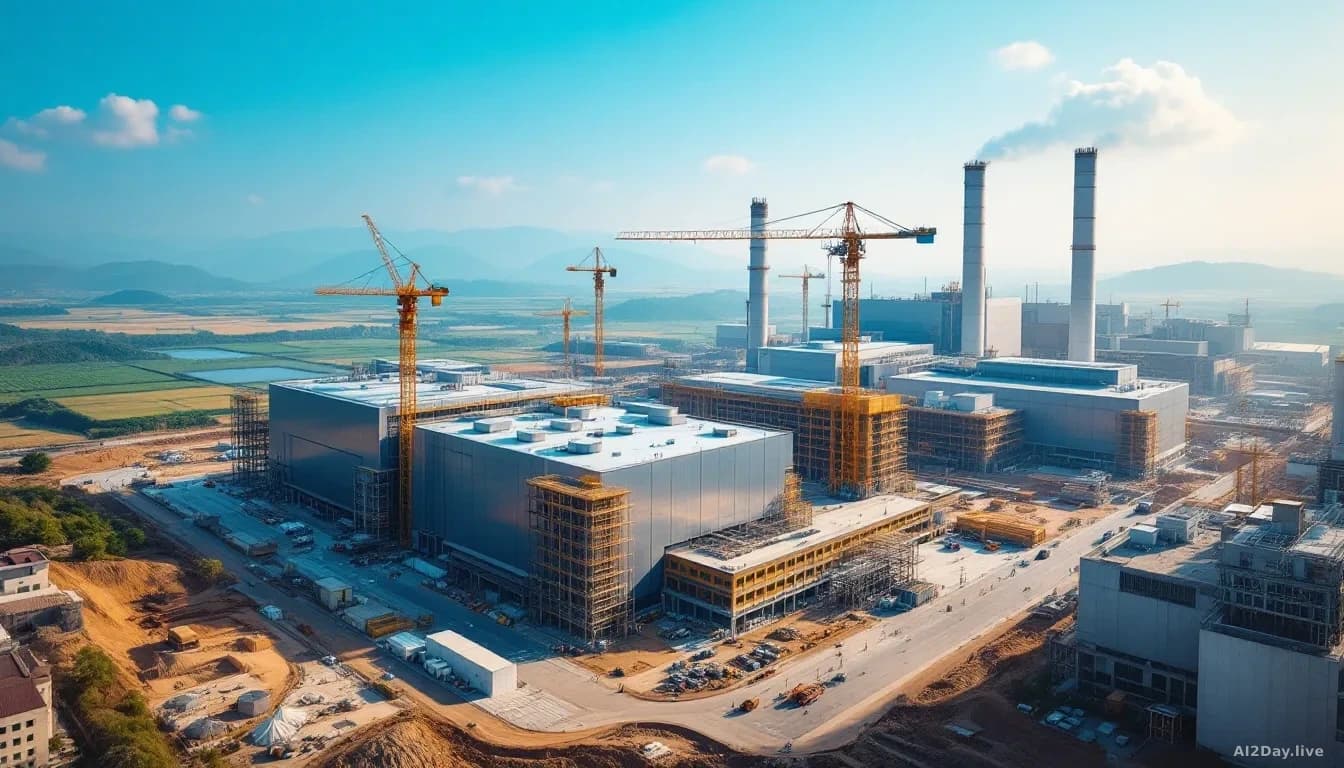
Thousands of construction workers are building a fifth semiconductor fab at Samsung's Pyeongtaek complex as the company races to catch SK Hynix in the memory chips that power AI.
Key points
- Samsung is building a fifth memory-chip factory at its Pyeongtaek complex, paused during a 2024 demand slump and restarted when AI orders climbed again.
- The site covers roughly the same area as New York City's Central Park and already runs three fabs around the clock, with a fourth coming online.
- Samsung predicts demand for memory chips will keep rising through 2028, driven by AI training and deployment.
- Domestic rival SK Hynix currently leads the global market for high-bandwidth memory, the type inside Nvidia's AI accelerators.
- Construction workers earn 140,000 won (about $97) a day, and many expect the AI boom to keep them steadily employed.
Choi Hye-rin boards a shuttle bus before dawn in Songtan, a working-class district south of Seoul. By the time most people finish breakfast, she is walking Samsung's Pyeongtaek construction zones, checking cable ducts and overseeing the chemicals her crew handles. She is 35 and a safety officer. She is not planning to leave. "The rate here is higher than other construction sites," she told MIT Technology Review, which visited the site. "You just keep coming back."
Hye-rin is one of thousands of workers keeping a build-out running that Samsung sees as its best shot at retaking a memory-chip market it has been losing.
Why does any of this matter for AI?
AI models run on GPUs (graphics processing units), and those GPUs depend on memory chips stacked directly onto the processor package. That type is called high-bandwidth memory, or HBM: layers of chips that feed data to the GPU fast enough to keep it busy. Without HBM, the most powerful AI chips cannot reach their potential. Samsung's Pyeongtaek complex is built around producing that memory at scale.
The catch is that SK Hynix has dominated HBM supply for the past few years, particularly for Nvidia's accelerators. That gap explains the urgency visible across the site, from scoreboard poem contests about safety culture to banners reading "Even if the work runs late, don't rush." The fifth fab was paused in 2024 when a memory glut cut demand, then restarted when AI orders climbed. Samsung now predicts HBM demand will keep growing through 2028.
How does this fit into the wider chip picture?
This is a memory story, not a logic-chip story, and that distinction matters. TSMC, the Taiwanese company that fabricates chips other companies design, has dominated what the industry calls the foundry business. AI2Day reported in October that TSMC pulled in $16 billion for September on a 54.6% year-on-year rise. Samsung is competing in a different layer: the memory that sits alongside logic chips.
On the HBM front specifically, our September story on SK Hynix showed that HBM is already pulling new manufacturing geography into play, with the South Korean firm exploring production inside Intel's Ohio factory. Memory supply has quietly become the bottleneck nobody headlines.
The Pyeongtaek expansion is a very physical answer to a physical problem. Tens of thousands of workers, years of construction, land the size of Central Park. Whatever happens with AI software, the chips still need to come from somewhere, and right now Samsung is betting billions that somewhere is a farming city south of Seoul.
Common questions
What is high-bandwidth memory and why does AI need it?
High-bandwidth memory, or HBM, is a type of memory chip stacked in layers and placed directly beside a processor to move data extremely fast. AI models handle enormous amounts of data during training and inference, and HBM lets the GPU access that data quickly enough not to sit idle.
Does this affect the price or availability of AI products?
Tighter memory supply pushes up the cost of AI chips and, eventually, the AI services that run on them. If Samsung narrows SK Hynix's lead in HBM, more supply should help keep a lid on prices over the next few years.
The real thing to watch here is not whether Samsung can build fast enough. It's whether its HBM yields are good enough to win back Nvidia's confidence. Construction is the easy part.