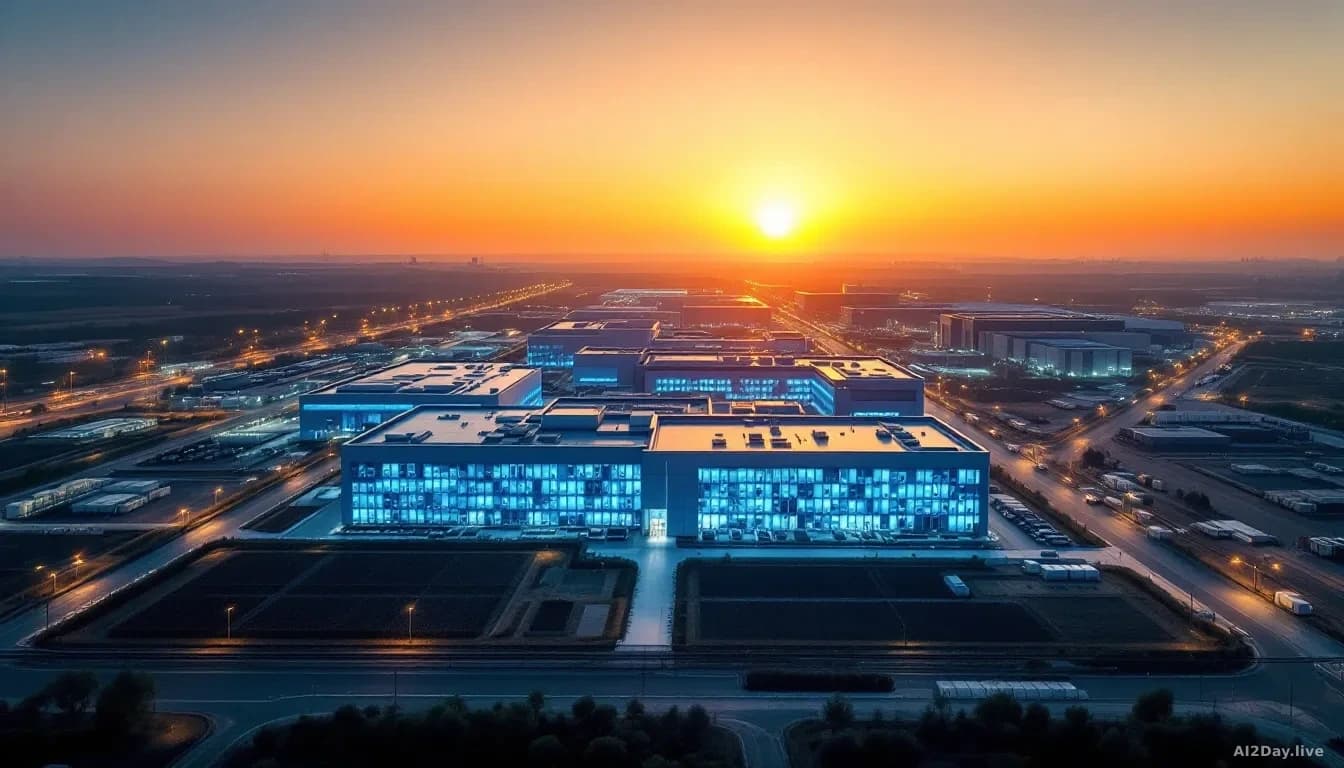
TerraPower's nuclear plant stores heat in molten salt. That could make it ideal for AI data centres.
The Bill Gates-founded startup plans to announce its first data centre deal this year. Its trick: keeping the reactor running flat-out while banking spare heat for the moments when demand spikes.

Key points
- TerraPower, the nuclear startup founded by Bill Gates, plans to announce its first data centre power project in 2025, with construction expected to begin in 2027.
- In January 2025, Meta agreed to buy eight of TerraPower's Natrium reactors, each rated at 345 megawatts.
- TerraPower's reactor stores surplus heat in a tank of molten sodium, letting it deliver extra electricity on demand without slowing the reactor down.
- American nuclear reactors run at full power 92.5 percent of the time, a higher rate than any other type of power plant.
- Unlike most nuclear plants, TerraPower's design can ramp output up and down quickly, making it compatible with grids that rely heavily on wind and solar.
Power is the bottleneck. Every company racing to build AI infrastructure is hunting for electricity that never stops flowing, and a growing number of nuclear startups say they're the answer. TerraPower, the company Bill Gates founded, is about to make that pitch more concrete.
First reported by Bloomberg, TerraPower plans to announce its first data centre power project later this year. The company didn't name the customer. Construction is expected to start in 2027, making it TerraPower's second plant after the one already being built in Wyoming. We first covered TerraPower's Natrium programme on 19 August 2026, around the same time we reported on the gas-plant bets that energy researchers say could backfire: context that makes this announcement worth watching.
Why does a nuclear plant need a heat battery?
AI workloads are electrically erratic. Training a large AI model pulls an enormous amount of power, then stops. GPUs, the specialised chips that handle AI's heavy computation, can swing from nearly idle to full power in minutes. That whiplash is so severe that natural gas turbines supplying some data centres have broken under the stress.
Nuclear reactors have the opposite problem. They run best when left alone at full output. A traditional reactor can only increase or decrease output by about 5 percent of its total capacity per minute, according to the National Laboratory of the Rockies, which makes chasing a spiky data centre load nearly impossible. Newer small modular reactors, compact factory-built nuclear units, can move at about 10 percent per minute, but running below capacity is still a poor way to earn back the construction cost.
TerraPower's solution is to stop trying to match demand in real time. The reactor keeps splitting atoms at a steady pace. Any heat it produces that the grid doesn't immediately need gets diverted into a large tank of molten sodium, a metal that holds heat exceptionally well. When demand surges, the plant draws on that stored heat to boil more water, spin its turbines faster, and push out extra electricity within minutes. The reactor never slows down.
What does this mean for AI companies shopping for power?
Data centres running off dedicated power, rather than drawing from the public grid, need generation that can follow their load. Battery banks can help, but they add cost. TerraPower's molten-sodium storage does that smoothing job as part of the plant's basic design, which is what makes this genuinely different from a standard nuclear pitch.
The company originally developed this feature to pair its reactor with wind and solar farms. A data centre's demand swings create a similar matching problem, just from the other direction.
TerraPower still faces the challenge every nuclear startup faces: its early plants will be expensive. Mass production of small modular reactors promises lower costs, but that benefit is years away, possibly a decade or more by TerraPower's own acknowledgement. Running at maximum output as often as possible is the only way to make the economics work now.
Meta's January commitment to buy eight Natrium plants signals that at least one major AI company sees the deal as worth making. Whether others follow before costs come down is the real test.
Common questions
Is this nuclear power safe for communities near data centres?
TerraPower's Natrium reactor uses molten sodium as a coolant rather than pressurised water. Sodium-cooled reactors have operated commercially before, and the design is regulated by the US Nuclear Regulatory Commission. The Wyoming plant under construction will be the first modern demonstration of this specific design.
When would this actually deliver power?
TerraPower expects to break ground on the data centre project in 2027. Nuclear plants typically take several years to build, so commercial power from this project is unlikely before the early 2030s.