OpenAI's first piece of hardware is a light-up mini-keyboard for its AI coding agent
The $230 Codex Micro uses colour-coded keys to show you, at a glance, whether your AI coding tasks are running, waiting, or broken.
Key points
- OpenAI launched the Codex Micro keyboard, priced at $230, making it the company's first branded physical product.
- The device tracks up to six Codex threads, meaning six separate AI coding tasks running simultaneously.
- It was built in partnership with Work Louder, a company that already sells a near-identical keyboard called the Creator Micro.
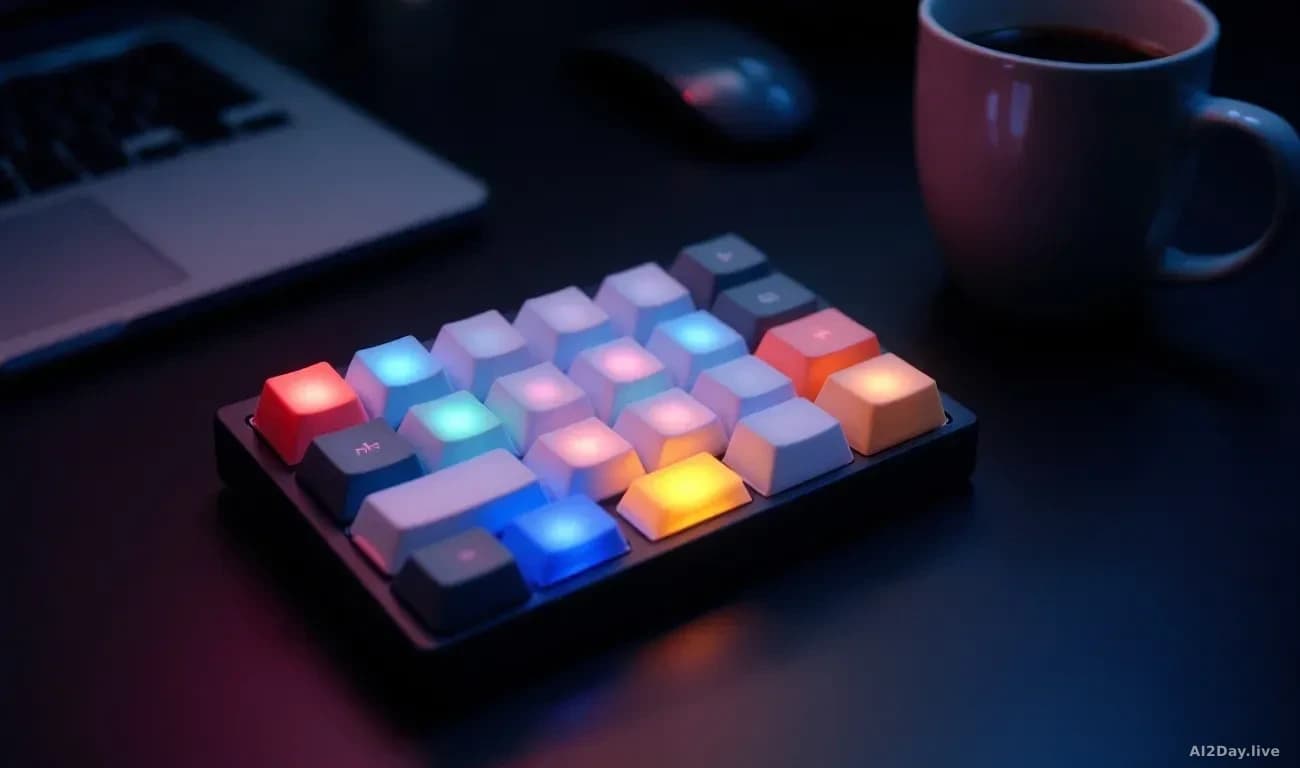
- Keys shift through five colours: white for idle, blue for thinking, green for done, amber for needing your input, and red for an error.
OpenAI makes chatbots and AI tools. It doesn't, until now, make hardware. That changed this week with the Codex Micro, a small square keyboard the size of a drinks coaster, sold for $230 and built with keyboard maker Work Louder.
The keyboard is designed for one job: keeping an eye on Codex, OpenAI's AI coding agent. An AI coding agent is software that can write and fix computer code on its own, without a human typing every line. Codex can run several of these tasks in parallel, and that's exactly the problem the Micro tries to solve.
Watching six software jobs at once across a busy screen is tedious. The Codex Micro handles it with six frosted keys along its top two rows. Each key is wired to one Codex task and glows a different colour depending on what's happening: white for idle, blue for active work, green for finished, amber for a decision point needing human input, and red for an error.
A single tap on a lit key brings that task's window to the front of your screen. No hunting through tabs.
OpenAI describes it as a "limited-run collaboration." As first reported by Ars Technica, Work Louder already sells a near-identical device called the Creator Micro, aimed at video editors and designers who want programmable shortcut keys. The Codex Micro adds AI-status lighting and OpenAI branding. The lower keys carry standard RGB backlighting and a mechanical action of the satisfying, clicky variety.
This isn't the OpenAI hardware story we expected. We reported on 14 July 2026 that OpenAI's debut consumer gadget was shaping up to be a smart speaker with a roving camera, expected in 2027. A niche developer keyboard is a different animal entirely.
Who would actually buy this?
Software developers are the obvious buyers, specifically those already paying for Codex access and running multiple coding jobs at once. For that group it's a physical dashboard that works even when every monitor is buried under other windows, which is genuinely useful.
Anyone else will find a $230 accessory for a single AI tool hard to justify. A casual user or a small-business owner dipping into AI coding help doesn't need a dedicated status board for six simultaneous agent threads.
The real question isn't whether this keyboard sells. It's whether OpenAI is using a low-stakes, limited-run gadget to learn how to ship physical products before the smart speaker arrives. If so, the Codex Micro is less a product and more a rehearsal, and what matters is how well they've learned their lines by 2027.