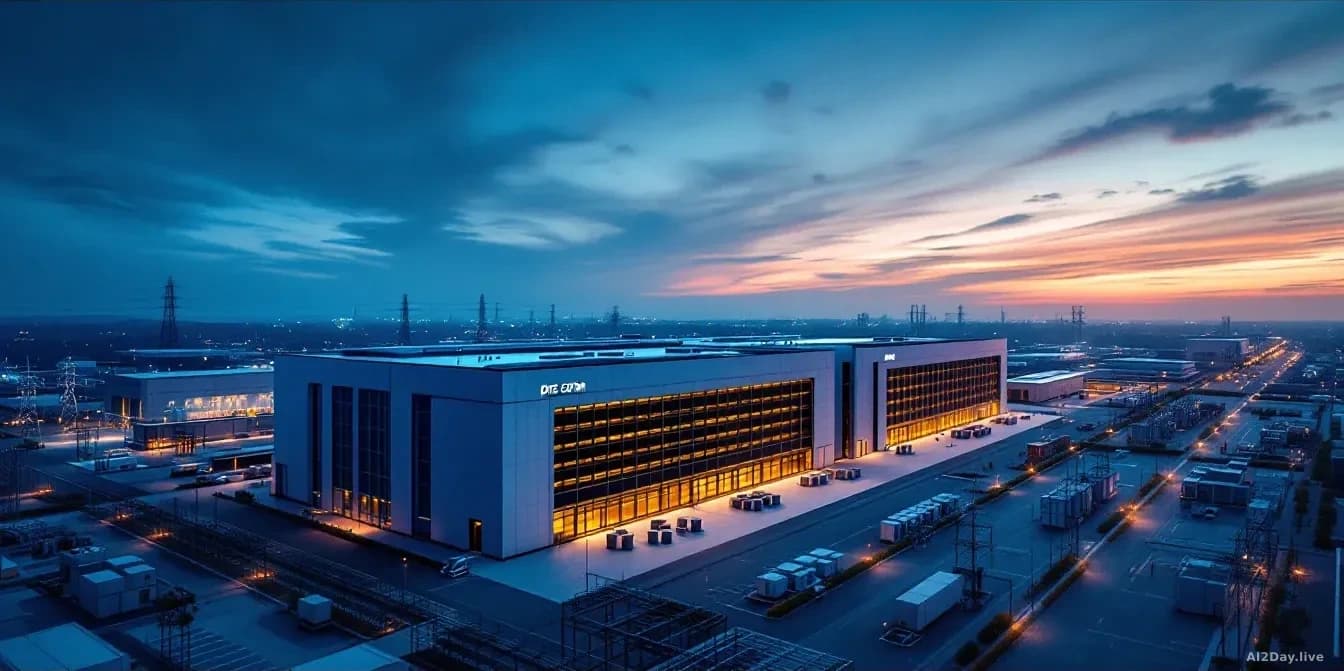
LinkedIn Is Freezing Its AI Data Center Spending for a Full Year
While rivals pour billions into new chips and server farms, LinkedIn says it doubled the efficiency of its existing hardware and saved $24 million in the process.

Key points
- LinkedIn will hold its AI computing infrastructure flat through June 2026, buying no meaningful new capacity.
- The company doubled GPU efficiency over six months, the equivalent of adding roughly 1,100 chips running around the clock without purchasing a single one.
- LinkedIn estimates those efficiency gains saved $24 million over the past 12 months.
- Server prices have tripled in recent months, according to LinkedIn's infrastructure chief, making the freeze harder to sustain.
- The move is a rare public counterpoint to the spending race between OpenAI and Google.
LinkedIn, the professional networking site owned by Microsoft, says it will not expand its AI computing infrastructure this fiscal year. The company told Wired AI it plans to keep its investment in GPUs (the specialised chips that do the heavy number-crunching AI needs) completely flat through June 2026, with storage capacity also unchanged.
That's a striking commitment for a platform with 1.3 billion users that is simultaneously rolling out more AI features, not fewer.
How did LinkedIn pull this off?
The company got far more work out of the hardware it already owns. Over the past six months, LinkedIn's engineering teams doubled the efficiency of their GPU usage, squeezing the same computing power from the same physical chips by wasting less of their idle time.
LinkedIn owns its own data centres in Oregon and Texas, having stepped back from Microsoft's Azure cloud service around 2022. That ownership gave engineers direct control over every layer of the technology stack.
They used a technique called distillation, where a smaller AI model is trained to learn from larger ones. For LinkedIn's job-recommendation tool, one compact model now handles what previously required two separate, more expensive models. It's cheaper to run and, according to LinkedIn's chief technology officer for engineering Erran Berger, no less accurate. "People are finding and discovering jobs that they were not successfully finding before," he said.
The team also rewrote some low-level software so that certain tasks run on standard CPUs (the general-purpose chips found in any computer) instead of pricier Nvidia GPUs, reducing electricity use in the process. LinkedIn says GPU utilisation on its training systems now runs above 95 percent, meaning the chips sit idle almost never.
All told, those changes saved an estimated $24 million over the past twelve months.
Does $24 million matter to a company this size?
Not hugely on its own. LinkedIn has $18 billion in annual revenue, so the saving is a small fraction of sales. LinkedIn's infrastructure chief Raghu Hiremagalur acknowledged that directly, but argued the real value is agility: engineers can start their next AI project sooner without waiting for new hardware to arrive.
The freeze also comes at a difficult moment to buy servers. Hiremagalur said some hardware has tripled in price in the past few months. LinkedIn locked in purchases before prices spiked, giving it a cost cushion its competitors may not have. Our 28 July story on Google's ballooning capital costs showed how that kind of price pressure is rattling investors across the industry.
| Metric | Figure |
|---|---|
| LinkedIn users | 1.3 billion |
| Fiscal year covered | July 2025 to June 2026 |
| Estimated savings (12 months) | $24 million |
| GPU equivalent saved | ~1,100 chips, full-time |
| GPU utilisation rate (training) | above 95% |
| LinkedIn annual revenue | $18 billion |
What does this mean for ordinary users?
For LinkedIn members, AI features should keep improving despite the spending cap. Better job recommendations and smarter candidate-matching tools are already in production. The honest concern is that a hard spending ceiling could eventually force LinkedIn to slow its AI ambitions if computing demand keeps climbing faster than efficiency gains can offset it. That's the bet the engineers are making, and it's worth watching closely.
Common questions
Will LinkedIn's AI features get worse because of this?
LinkedIn says no. The company argues its efficiency work has actually improved results for job-seekers and recruiters, and it plans to keep launching new AI tools within the same computing budget.
Why are other big tech companies spending so much more?
OpenAI and Google are building entirely new AI systems that require vast amounts of fresh computing power. LinkedIn is building on top of models that already exist, which means it can focus on squeezing more from less rather than starting from scratch.
Could LinkedIn change its mind mid-year?
Yes. Berger and Hiremagalur both acknowledged that AI hardware demands shift quickly, and rising memory chip prices could force a rethink. The company says it's already factored in those price surges, but the plan isn't guaranteed.