37 Researchers Say Science Should Stop Writing Papers for Humans and Start Writing Them for AI
A new proposal wants to replace the traditional scientific paper with a format built around AI agents. The researchers behind it say the 350-year-old PDF is holding science back.
Key points
- In May 2025, 37 researchers from roughly two dozen universities and tech companies published a paper on ArXiv calling for the end of the traditional scientific paper.
- The paper proposes replacing it with an "Agent-Native Research Artifact" (ARA), a format designed for AI agents to read, reproduce and act on research autonomously.
- Lead author Jiachen Liu completed her computer science PhD at the University of Michigan in 2025 and co-founded the Agent Native Research Lab in Palo Alto in May 2025.
- The authors argue that standard papers discard roughly 80 percent of the useful information from the original research before publication.
- Liu argues there'll come a point where AI has absorbed all expert human knowledge and no longer needs people to guide it.
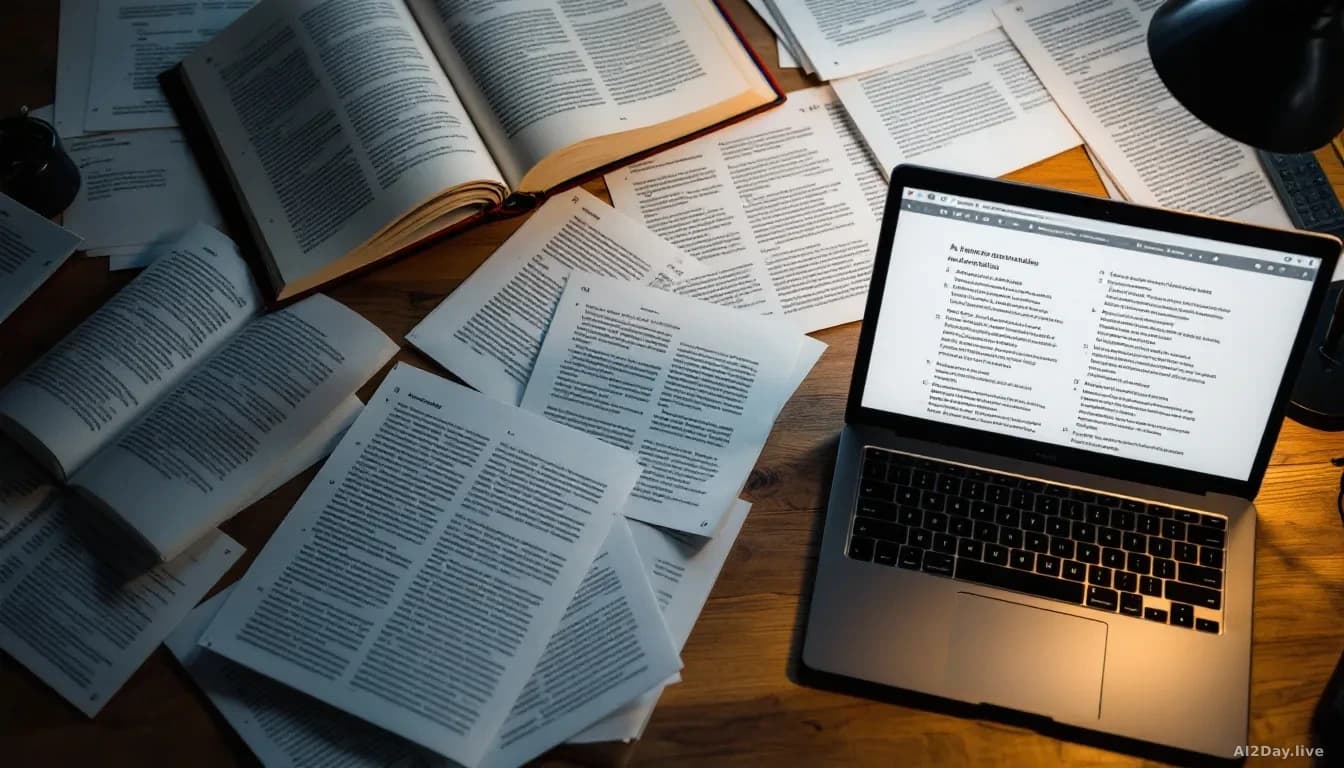
A paper published on ArXiv this May carries a deliberately provocative title: "The Last Human-Written Paper." Its 37 authors, drawn from roughly two dozen universities and tech companies, argue that the scientific paper, a format invented about 350 years ago, is no longer fit for purpose. Not because scientists have changed, but because AI has.
Their argument, as reported by IEEE Spectrum, goes like this: AI agents (software that can carry out multi-step tasks on its own, reading sources and drawing conclusions) are already doing serious work in research labs. But the traditional paper, a polished narrative written for human readers, is a terrible instruction manual for a machine.
What is actually wrong with the scientific paper?
The authors identify two core problems. First, the "storytelling tax." A finished paper captures maybe 20 percent of what actually happened during the research. The failed experiments, the parameter tweaks, the dead ends that took weeks: all gone. An AI trying to reproduce the work hits a wall almost immediately.
Second, the "engineering tax." Even the information that does survive is often too vague or incomplete to act on. Key implementation details get left out, or described in language too ambiguous for a machine (or, honestly, another human) to follow reliably.
Their proposed fix is the ARA, short for Agent-Native Research Artifact. Think of it less like a document and more like a living log. A built-in tool called the "Live Research Manager" automatically observes and records everything a researcher does as they work, so nothing's lost. If you still want a traditional PDF at the end, the system can generate one from the full record.
Won't AI just make things up?
This is the obvious worry, and Liu takes it seriously. Large language models, the AI technology behind tools like ChatGPT and Claude, work on probability rather than strict logic, which means they can "hallucinate," confidently stating things that are simply wrong. We looked at why that happens at the image level in our 3 August story on Apple's hallucination research; the problem runs just as deep in text.
Liu's answer isn't to use a second AI to check the first. Instead, she's building what she calls a formal system using neurosymbolic techniques, an approach that combines a neural network's ability to handle messy real-world information with the hard logical rules of classical computing. Every claim in an ARA would need to be expressible as a mathematical formula and provable by the system. No formula, no claim.
That's ambitious. It's also, she admits, still a work in progress.
What does this mean for working scientists?
For most researchers right now: not much changes immediately. The ARA is a proposal, not a standard anyone's adopted yet. But the underlying tension is real and growing. Evidence already suggests AI tools can boost individual careers while producing fewer genuinely new ideas across a field as a whole.
Liu goes further than most. She recently wrote an article called "The End of Human-in-the-Loop," arguing there'll come a point where AI has absorbed all expert human knowledge and no longer needs people to guide it. Whether that sounds exciting or alarming probably depends on how you feel about your morning coffee.
My read: the ARA's strongest case isn't the sci-fi endpoint Liu describes. It's the boring, immediate one. Science already has a reproducibility problem, and losing 80 percent of the research process before publication is a big part of why.
Common questions
Could scientists just teach AI to read normal papers better?
Liu says a smarter reader isn't the solution because the information was never in the paper to begin with. Roughly 80 percent of the research process, including the decisions and failures, gets discarded before publication, so there's nothing left to extract.
Is the ARA available to use now?
The paper itself is online in ARA format as a demonstration, and Liu's Agent Native Research Lab is an early-stage startup working on the tooling. No widely available product exists yet.
Who is funding or backing this work?
Liu co-founded the Agent Native Research Lab as a startup in Palo Alto in May 2025. The original research was conducted as part of her PhD work at the University of Michigan, completed in 2025.