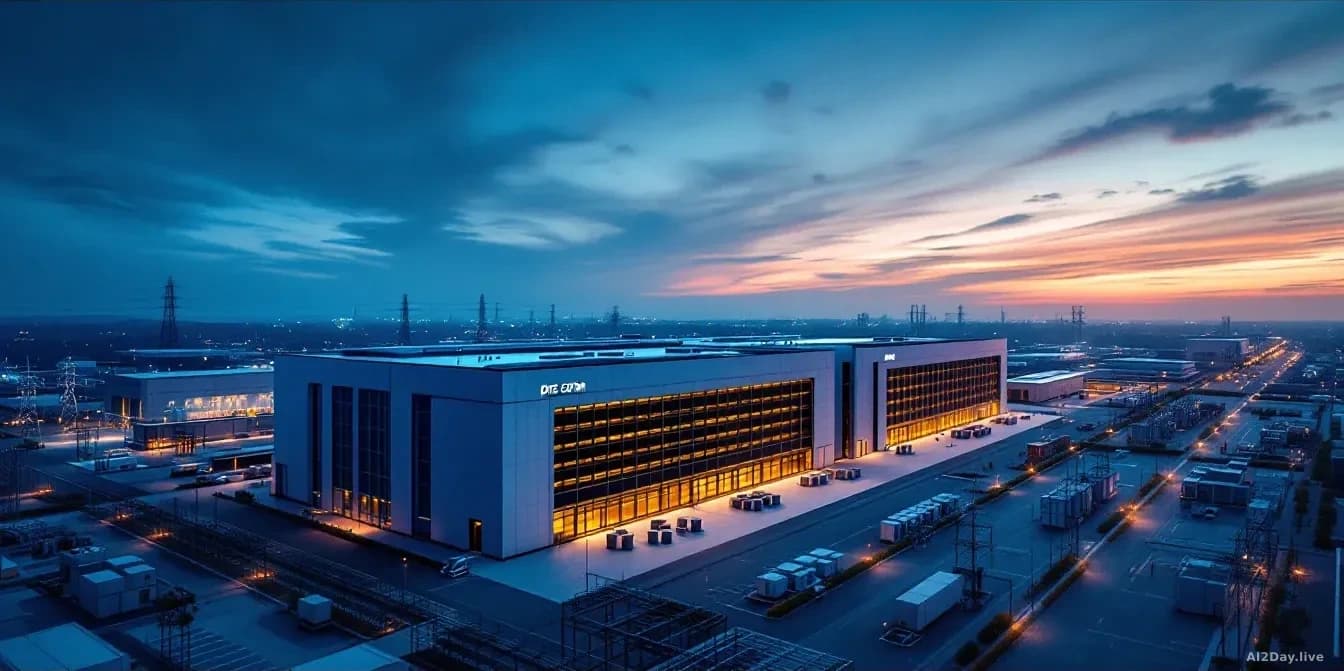
What has to go right for the AI spending gamble to pay off
A handful of tech giants are spending at a scale that dwarfs any industry investment in history. A Wharton finance professor ran the arithmetic and the answer is both clear and sobering.

Key points
- Five hyperscaler companies, Alphabet, Microsoft, Amazon, Meta and Oracle, are on track to spend roughly $750 billion on AI data centres in 2025 alone.
- Total AI revenues across the industry are estimated at $150 billion to $200 billion this year, a fraction of the spending.
- Wachter's analysis finds the hyperscalers need a 2.7-fold productivity increase to break even by 2030, once depreciation and the cost of capital are counted.
- Cumulative hyperscaler capital spending could reach $1.1 trillion by 2027 and upwards of $5 trillion across the coming four years.
- Alphabet, normally a cash-generating machine, reported a free-cash deficit of $5.9 billion in its latest quarter, its first shortfall since the company went public in 2004.
Jessica Wachter is a finance professor at the University of Pennsylvania's Wharton School, and she didn't try to predict whether AI would be brilliant or a bust. She just did the accounting.
Her starting point, first reported by MIT Technology Review, was what she calls a "remarkable fact" that nobody disputes: a small group of companies, known as hyperscalers, are spending extraordinary sums to build AI data centres, the warehouse-sized buildings packed with specialised computers that run AI software. She asked how fast their earnings would need to grow to justify the spending before the bills came due.
Uncomfortably fast, it turns out.
What does the money actually look like?
The five companies doing most of the spending will collectively spend around $750 billion on AI infrastructure this year. Projections suggest the total could climb past $5 trillion across the next four years, amounting to roughly 3% of US GDP. We covered Oracle's own piece of that bet on 14 September, when its cloud infrastructure revenue more than doubled even as the company took on over $100 billion in debt.
Set against that is the revenue side. Gary Gensler, who ran the US Securities and Exchange Commission under President Biden and now teaches at MIT's Sloan School, puts total AI revenues at $150 billion to $200 billion this year. "The challenge," he says, "is that the spending does not have commensurate revenues yet. That's a fact."
| Company / figure | 2025 estimate |
|---|---|
| Hyperscaler capex, 2025 | ~$750 billion |
| Total AI revenues, 2025 | $150bn to $200bn |
| Cumulative capex by 2027 | ~$1.1 trillion |
| Alphabet free-cash deficit, latest quarter | $5.9 billion |
| Productivity growth needed to break even by 2030 | 2.7x |
The gap between spending and income isn't unusual for an early-stage industry. What's different here is the sheer scale and the speed at which debt is accumulating. Free cash flow, the money left after a company covers its operating costs and capital bills, is expected to turn negative across the group soon.
Why could this go badly wrong?
Three interlocking problems make the numbers tricky to hit.
First, the data centres age fast. The GPU chips inside them, specialised processors that handle the heavy computation AI requires, roughly double in performance every two years. A data centre built today could look outdated before the decade ends, requiring billions more in upgrades to stay competitive. Princeton's Mihir Kshirsagar warns that without those upgrades, the buildings risk becoming "hulks," stranded assets with no useful purpose.
Second, revenue growth alone won't be enough. Columbia Business School finance professor Stijn Van Nieuwerburgh calculates that if planned AI computing capacity is built out between 2025 and 2032, investors will need to see roughly $3.7 trillion in annual revenues by 2032 to earn a 10% return. That is not a typo.
Third, the broader economy has to actually benefit. Businesses paying for AI subscriptions and tools will eventually need proof that the technology makes them more productive. If that proof doesn't arrive, spending will stall.
Wachter's paper puts it plainly: if the productivity boom "fails to materialise," the current AI buildout would be "the largest misallocation of capital in history."
Should ordinary people be worried?
Not immediately panicked, but paying attention is sensible. The companies involved have deep pockets and can absorb losses for a while. The danger builds if debt grows faster than revenues do, and if the loans get passed to pension funds and ordinary investors through financial markets.
Watch whether AI tools are actually making workplaces more productive over the next two to three years. That's the honest test. Measurable efficiency gains in your job or industry mean the investment thesis holds. Persistent novelty with no bottom-line impact means the financial pressure on these companies will intensify in ways that ripple outward.
That's the bet being placed, with your economy's money, right now. The numbers don't lie; what we don't yet know is whether the technology will.