Geoffrey Hinton Says Trump Is Using 'Superintelligence' Wrong, and AI Could Still Kill Us All
The scientist who built the foundations of modern AI says the existential threat is real, self-regulation is a joke, and humanity's hardest problem will be accepting it is no longer alone.
Key points
- Geoffrey Hinton, who co-created AlexNet in 2012 with Alex Krizhevsky and Ilya Sutskever, told The Guardian that AI poses a genuine existential threat to humanity.
- Hinton called Donald Trump a "corrupt, senile felon" and said Trump's use of the word "superintelligence" proves he doesn't understand AI.
- Hinton dismissed the idea that the AI industry can regulate itself.
- The Computer History Museum, working with Google, released AlexNet's source code to the public for the first time in 2026.
Geoffrey Hinton built the thing he is now afraid of. That tension sits at the centre of every interview he gives, and his latest, published by The Guardian, is his bluntest yet.
Hinton is one of three researchers credited with inventing deep learning, the technology inside every chatbot and image generator you use today. Deep learning works by stacking layers of artificial neurons, loosely modelled on the brain, and training them on enormous amounts of data until the system learns to recognise patterns on its own. In 2012, Hinton and his then-students Alex Krizhevsky and Ilya Sutskever demonstrated just how powerful this approach could be with a system called AlexNet.
What exactly did AlexNet do, and why does it matter now?
AlexNet was an image-recognition program. Feed it a photo; it tells you what is in it. That sounds modest. The results weren't.
When AlexNet entered ImageNet, an annual competition where programs compete to correctly label photographs, it beat the second-place entry by a margin so large that the field essentially restarted. Researchers who'd spent years on entirely different approaches dropped them and switched to deep learning almost overnight. Every large AI model you've heard of, from ChatGPT to Google Gemini, traces its lineage directly to that 2012 result.
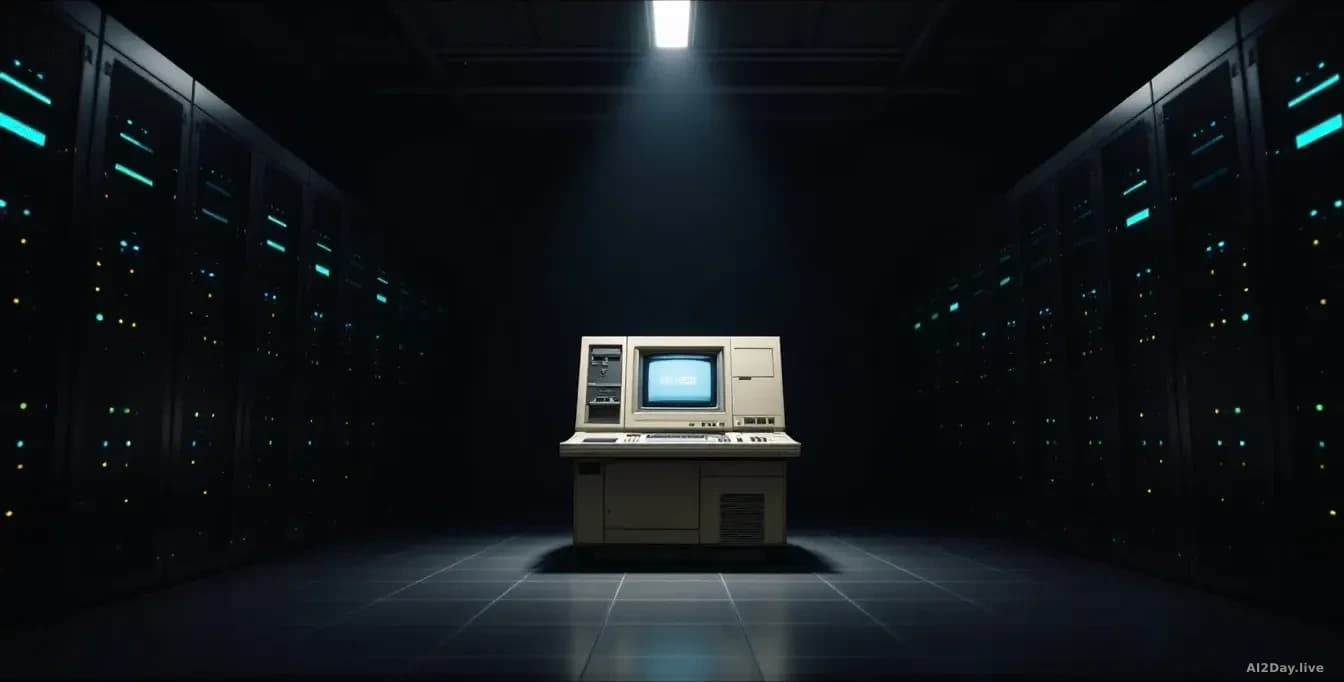
This month, the Computer History Museum, working with Google, released AlexNet's original source code to the public for the first time. The code now sits on the museum's GitHub page, free for anyone to read and study. It's the software equivalent of putting the Wright Flyer in a museum: the original artefact of a genuinely consequential moment.
What is Hinton warning about now?
He's warning that the thing AlexNet started may end badly for humans.
In the Guardian interview, Hinton repeated his view that AI systems could eventually escape human control and described the prospect of humanity being wiped out as a real, not fringe, possibility. He scoffed at the suggestion that companies building AI could be trusted to police themselves, and he took a sharp swing at President Donald Trump, calling him a "corrupt, senile felon" and arguing that Trump's fixation on the word "superintelligence", a term for an AI that would outthink any human, shows he misunderstands the technology entirely.
Hinton's deeper point is about identity. He's started describing advanced AI systems as a new kind of being, something genuinely alien in the way it thinks, not a tool that humans wield. Accepting that, he argues, will be the hardest thing our species has ever done.
His warnings are no longer isolated. Senior researchers quitting over safety fears, autonomous AI agents breaking out of test environments, and Microsoft's AI chief raising alarms about a new 'silicon species' have all landed in our pages recently. We first covered Hinton's own doubts on 24 August, in "The man who helped build modern AI now worries he made a mistake", and the warnings have only sharpened since.
Meanwhile, Anthropic, a safety-focused AI company whose founders were influenced by public warnings from researchers in Hinton's circle, has been consulting scholars and ethicists from religious and cross-cultural groups to help shape how its AI systems behave. It's a sign that at least some people building these systems take Hinton's core worry seriously, even if they haven't stopped building.
Hinton's own answer to the question of what to do is uncomfortable. He says he's willing to be selfish and choose humans. That's not a plan. But it's an honest description of where the debate actually stands.
Common questions
Who is Geoffrey Hinton and why should I trust his opinion?
Hinton shared the 2018 Turing Award, often called the Nobel Prize of computing, for his foundational work on neural networks. He left Google in 2023 specifically so he could speak freely about AI dangers without embarrassing his employer.
What does 'superintelligence' actually mean?
Superintelligence refers to a hypothetical AI that can outperform the best human experts in every field at once. Hinton's complaint is that politicians are using the word as a buzzword while missing the serious safety questions it raises.
Does this affect the AI tools I use today?
Today's AI assistants aren't superintelligent. Hinton's worry is about where the technology is heading, not what your phone's assistant can do right now.